Works with the AI tools you already use
 Claude Code
 Cursor
 Codex CLI
 Muse
Muse Dots+22 moreClaude CodeCursorCodex CLIMuseDots
 OpenClaw
 Manus
Manus Grok
Grok Grok Bot+18 agents
Dual-Cognition Intelligence System
Alternates between human intuition and AI analysis to produce deeper, more realistic decisions and insights.
$10

Dual-Cognition Intelligence System
Example session with this skill installed
Imagine a government introduces a highly efficient AI-driven public surveillance system that objectively reduces crime rates by 40%. Technically the system works extremely well, but public trust slowly begins eroding over time. Analyze the long-term consequences beyond just the surface-level benefits and risks.
- Read your context and instructions
- Compiled the dual-cognition intelligence system
This is a rich, multi-layered problem — exactly the kind that needs both cognitive modes running together. Let me work through it fully.
🧠 Intuitive Layer — What this feels like before the analysis begins
Before examining the data, something subtle stands out: a 40% crime reduction isn't just a statistic — it's a seduction. Governments and citizens alike will find it almost impossible to argue against results that concrete. And that's the trap.
What feels significant here isn't the surveillance itself. It's the
asymmetry of visibility: the system sees everything, and the citizen sees nothing about how they're being seen. That asymmetry does something to human psychology over time. People don't just change their behavior when watched — they change their sense of self. The internal voice that says "I could do this, but I won't" gradually gets replaced by an external one that says "I cannot do this." That's a quiet, invisible erosion of human agency.
There's also something that feels like a
ratchet mechanism at work. Once crime drops 40%, that number becomes the baseline. Any future relaxation of surveillance will be blamed for any crime that follows. The system becomes politically irreversible — not because it's right, but because removing it feels dangerous.
And underneath all of this: who controls the definition of what the system watches for? Today it's crime. Tomorrow?
🔬 Analytical Layer — Stress-testing those intuitions
Structurally, what are the documented consequences of mass surveillance systems?
The evidence from existing implementations (China's social credit experiments, CCTV saturation in the UK, predictive policing in the US) points to several non-obvious effects:
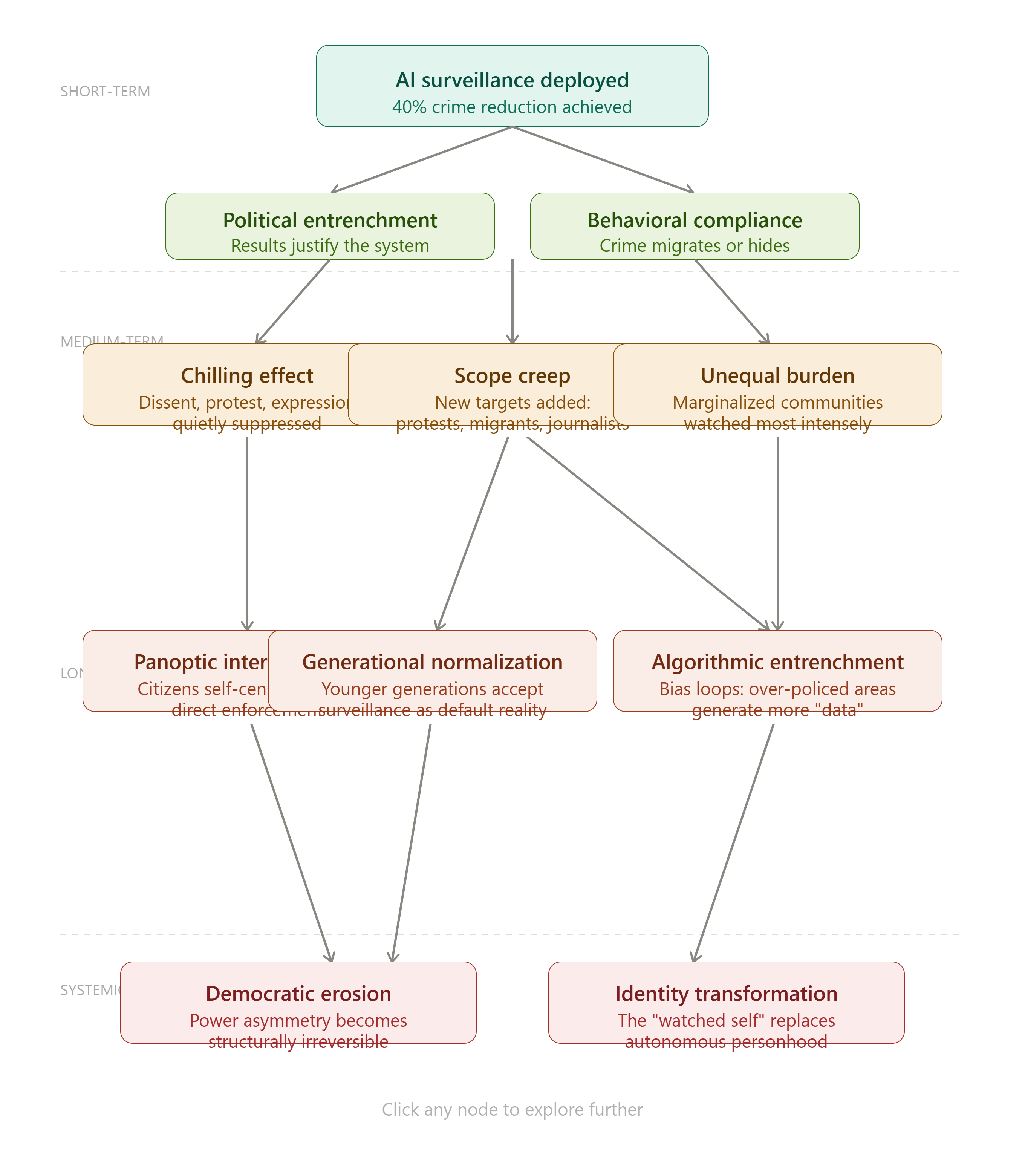
Behavioral displacement, not elimination. Crime doesn't disappear — it migrates. Surveilled zones push activity to unsurveilled margins, online spaces, or private settings. The 40% reduction may reflect displacement rather than genuine behavioral change.
Chilling effects on legitimate behavior. Research consistently shows that surveillance suppresses not just criminal behavior but lawful dissent, political organizing, religious practice, and unconventional expression. The cost is diffuse and invisible in crime statistics.
Institutional capture risk. The question isn't whether the current government is trustworthy. It's whether the infrastructure remains trustworthy across administrations, political shifts, and institutional drift. A system built for crime prevention is also a system capable of targeting journalists, activists, or political opponents — regardless of original intent.
Erosion of trust asymmetry creates perverse incentives. When citizens cannot monitor state behavior but the state can monitor all citizen behavior, the power imbalance fundamentally restructures the relationship. Historically, this tends to produce compliance theater — citizens behave as if surveilled even when not, and the state takes increasingly fewer accountability measures because visibility flows only one way.
What about the trust erosion the question mentions? This is analytically significant. Trust erosion typically precedes institutional degradation, not follows it. When public trust in a system erodes, it usually means the system is already behaving in ways that haven't been publicly disclosed yet.
🔄 Re-Intuition Layer — Where does pure analysis fall short?
The analytical picture is compelling, but it risks being too abstract. Human beings don't respond to surveillance primarily as rational agents calculating power asymmetries. They respond emotionally, socially, and generationally.
Generational normalization is the sleeper effect. People who grow up under pervasive surveillance don't experience it as surveillance — they experience it as the world. The generation that remembers life before the system will feel the loss of privacy viscerally. Their children won't. The political resistance to surveillance tends to weaken generationally, not strengthen — which inverts the intuitive assumption that people will eventually revolt.
Social stratification of the surveillance burden. The system almost certainly doesn't watch everyone equally. Marginalized communities, those in high-crime areas (often lower-income), and those already marked by prior contact with the justice system will bear the sharpest surveillance burden. The middle-class professional who benefits from safer streets while being largely unwatched will experience the system very differently than the person in a surveilled neighborhood who feels like they live in a panopticon.
The psychology of safety as justification. Safety is an extraordinarily powerful political emotion. The government doesn't need to force citizens to accept surveillance — it just needs to keep the crime statistics visible and the surveillance infrastructure invisible. Citizens will rationalize the trade-off themselves. This is how liberal democracies can drift toward surveillance states without any single moment of obvious authoritarian rupture.
⚖️ Synthesis — The calibrated picture
Here's where intuition and analysis genuinely agree and genuinely conflict:
Where they agree: The technology works as advertised, and that's precisely the danger. Systems that work are the ones that become permanent and expand. The 40% reduction is real — and it buys political cover for everything that follows.
Where they conflict: Analysis says the risks are structural and long-term. Intuition says the felt reality is more insidious — it's not that people will be abused obviously, it's that the texture of daily life quietly transforms. People stop gathering. Stop protesting. Stop being privately strange in public. Not because they're told to, but because they've internalized the watching. Foucault called this the "panoptic effect" — you don't need guards in every tower if people behave as if there are.
What remains genuinely unresolved: Whether democracy can structurally constrain this kind of infrastructure in the long run. The evidence is mixed. Some democracies have built meaningful oversight frameworks. Many have not. The variable isn't the technology — it's the institutional health of the society adopting it.
Let me render the long-term consequence cascade visually:
Connects securely to your tools. The creator never sees your data.
What you get
About this skill
Description
- Uncovers Hidden Dynamics — Looks beyond surface-level facts to identify unstated motivations, emotional tensions, social forces, behavioral patterns, and subtle signals.
- Dual-Cognition Reasoning — Deliberately alternates between intuitive human-style interpretation and structured analytical evaluation instead of relying on a single reasoning mode.
- Stress-Tests Intuition — Challenges instinctive impressions with evidence, logic, causal reasoning, overlooked variables, contradictions, risks, and edge cases.
- Thinks Like People Actually Behave — Re-examines analytical conclusions through the lens of identity, fear, pride, loyalty, narratives, social pressure, and perception rather than assuming humans always act rationally.
- Resolves Complex Tensions — Identifies where intuition and analysis agree, where they conflict, and what each perspective reveals that the other misses.
- Handles Uncertainty Intelligently — Separates known facts, inferences, emotional suspicions, validated conclusions, unresolved questions, and assumptions instead of manufacturing false certainty.
- Adapts to the Problem — Changes the balance between intuition and analysis depending on whether the situation involves interpersonal conflict, forecasting, creativity, crisis, philosophy, or strategic planning.
- Designed for Complex Decisions — Particularly valuable when people, uncertainty, competing forces, psychology, or high stakes make ordinary logical analysis insufficient.
- Produces Reality-Aware Conclusions — Goes beyond theoretical correctness to produce conclusions that account for how people are actually likely to think, react, adapt, and behave.
How to install
Works the same in every agent - Claude, Cursor, Codex, Copilot and 20+ more.
- 1
Download the ZIP
Free skills download straight away. Paid skills unlock right after purchase.
- 2
Unzip into your skills folder
Every agent reads skills from one folder on your machine. Drop the unzipped folder in there.
- 3
Ask your agent to use it
Restart the agent if it was already running. It picks the skill up automatically - no config needed.
Skills folder by agent
Click the path to copy it. Create the folder if it does not exist yet.
Reviews
No reviews yet
Be one of the first to try it. Every listed skill passes our trust checks below.
Security scanned
Passed our 8-point scan before listing
Fresh listing
Recently published to Agensi
30-day refund
Not a fit? Get your money back
Trust & safety
Security scanned
Verified clean 21 days ago
- Passed all security checks, Safe to install