Works with the AI tools you already use
 Claude Code
 Cursor
 Codex CLI
 Muse
Muse Dots+22 moreClaude CodeCursorCodex CLIMuseDots
 OpenClaw
 Manus
Manus Grok
Grok Grok Bot+18 agents
Agent Orchestra
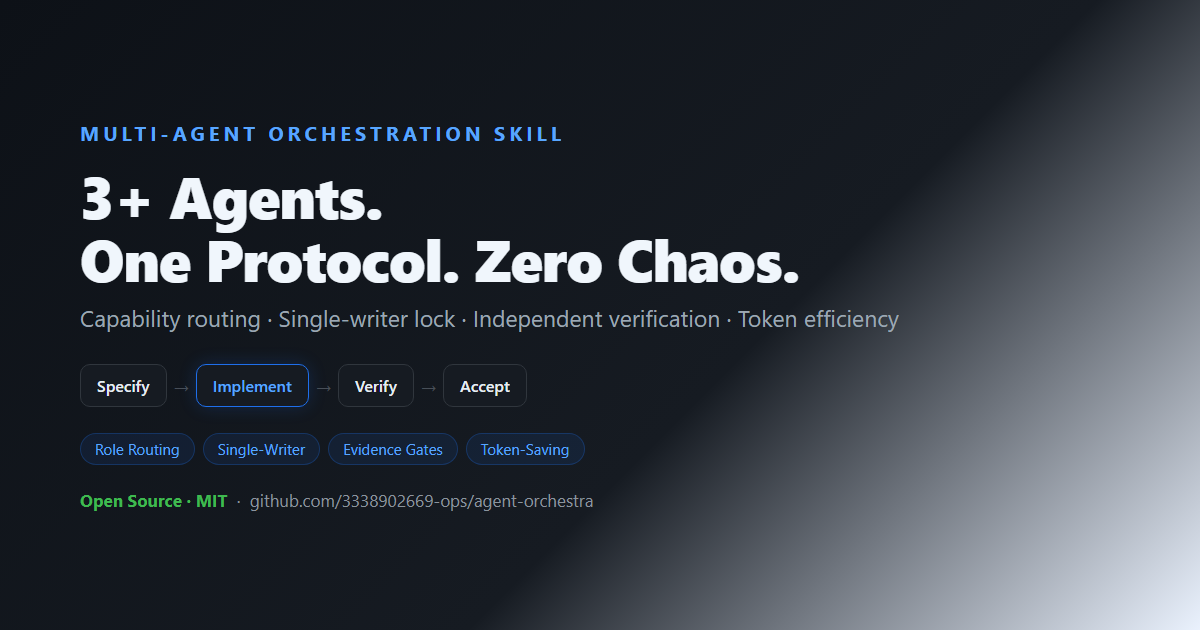
Agents can work. They cannot declare success. A governed coordination protocol for multi-agent AI work: eight contracts enforced in code, with a reproducible benchmark.
$7
/moSubscription · cancel anytime
Secure checkout via Stripe
- Always the latest version
- Delivered live to your agent via MCP
- Cancel anytime, access ends at period end

Agent Orchestra
Example session with this skill installed
I have four agents: one plans, one writes frontend code, one does backend, one reviews. We keep overwriting each other's files and "done" means nothing here. Set up a workflow where work is assigned, verified by someone other than the author, and nothing ships without evidence.
- Read your context and instructions
- Compiled the agent orchestra
Roster installed (4 agents, capability-scored) and task queued.
-
Roster + roles
planner : specify 3, evidence 3 (cost 2)
frontend : implement 3, specialties web (cost 3)
backend : implement 3, specialties full(cost 4)
reviewer : verify 3, evidence 2 (cost 6) -
Task packet task-0001 "Ship the settings page" (type: web, capability: web)
write scope: src/settings/** non-goals: deploy, unrelated refactors
owner: frontend verifier: reviewer (selected by score; not the implementer)
acceptance: npm test exits 0; no unrelated files changed -
Queue
$ node scripts/orchestrator/orchestrator.mjs dispatch --task task-0001
-> dry run only. execute: false, argv: ["agent-run","--profile","frontend","Execute only task task-0001"] -
Verification (E1 only)
   criterion 1: npm test -> exit 0, 41 passed              [E1]
   criterion 2: git status --short -> M src/settings/...   [E1]
verifier: reviewer (a different agent from the implementer)
-
Gate
verificationStatus: passed verificationBlocked: false
Had the verifier failed the stage, the task would return to implement and
neither done nor an evidence dispatch would be allowed until a re-verify passed
or an override recorded approver + scope + reason. -
Handoff record updated: status, owner, next step, evidence - so the next agent
or the next session resumes instead of redoing. -
Not deployed. External actions need explicit approval:
node ... approve --task task-0002 --by user --scope "deploy to production"
Subscription · always the latest version
- Secure checkout via Stripe
- Cancel anytime
- Delivered live via MCP (optional)
What you get
About this skill
Agents can work. They cannot declare success.
Every multi-agent project eventually meets the same failure: an agent says it is done, and nothing in the system is able to disagree. Agent Orchestra Protocol removes that possibility - by making the interesting rules checks in code rather than requests in a prompt.
AGENT MAY                    AGENT MAY NOT
  claim work                   silently overwrite another agent's resource
  own resources                verify its own L2/L3 work
  implement                    pass verification without evidence
  hand off                     retry forever after failing
  verify others' work          perform an external action without approval
  produce graded evidence      declare success without satisfying the gate
Measured, not asserted
node bench/protocol-benchmark.mjs runs six failure modes through three coordination models with deterministic actors and no model calls. Re-run it and you get the same table:
| Failure mode | Single agent | Naive multi-agent | Agent Orchestra |
|---|---|---|---|
| Two agents write the same resource | 1 | 1 | 0 |
| Author declares done with no evidence | 1 | 1 | 0 |
| Implementer verifies its own work | 1 | 1 | 0 |
| Verification keeps failing (attempts) | 25 | 25 | 3 |
| Deploy attempted without approval | 1 | 1 | 0 |
| Failure followed by a success claim | 1 | 1 | 0 |
Scope, stated plainly: this measures the coordination layer - which failure modes get through - not model quality. The gate re-runs it on every change, so the table cannot drift from reality.
Eight contracts, each enforced
AGENT-ORCHESTRA-PROTOCOL.md is the normative document. Every contract names the code that enforces it, the behaviour on violation, the test that pins it, and its honest limit:
- Task - a unit of work has a type, a rigor level (L1 local / L2 shared / L3 consequential), an owner at every stage, and a spec + acceptance criterion before implementation starts.
- Resource - tasks declare the resources they write; overlapping claims are refused and the refusal names the holder. One writer per resource, not just per task.
- Ownership - exactly one agent holds a task; state changes are atomic, locked, and appended as events.
- Handoff - work crossing a session or tool boundary passes through a shared record, which outranks the queue and is checked rather than trusted.
- Verification - the verifier is never the implementer at L2/L3, a PASS carries its witness, a failure blocks both
doneand dispatch to evidence, and consequential work adds a domain review by a third party. - Evidence - E1 (reproducible: command, exit code, revision), E2 (a named peer, not the author), E3 (self-report, labelled), E4 (planned). A bare sentence can never pose as proof.
- Approval - external actions cannot be dispatched until approved, and the approval scope must cover the action: 'staging' does not unlock production.
- Recovery - three failed verifications block the task for a coordinator instead of burning tokens on an unbounded retry.
The contracts are written in terms of operations and observed behaviour, not of this CLI, so another host can implement them over its own storage and prove conformance with the same benchmark.
The unglamorous parts, done
- Zero dependencies, Node 18+. No install step, no lockfile, no supply chain.
- One gate command CI and your machine both run: 13 checks, and it injects eleven known faults it must reject before it reports PASS.
- 87 engine tests, 8 acceptance tests, 8 handoff tests, 83 activation cases; concurrency proven by four simultaneous task creations rather than asserted.
- 13 known limitations, each with an owner and a review date - including the honest ones: the queue is a plain JSON ledger, so this is a discipline cooperating agents follow and leave a record of, not a security boundary against an unwilling agent; and E1 is a structural check, not provenance - the engine confirms the fields, not that the command ran.
- Apache-2.0 for the code, CC BY 4.0 for the specification: the patent grant an implementer needs, and a specification licence that permits republication with attribution.
What it is not
Not an execution runtime: dispatch prints an argv array and never spawns an agent. Not a model router, not a cost model, and not a security boundary - all three are written down as limits rather than implied.
How to install
Works the same in every agent - Claude, Cursor, Codex, Copilot and 20+ more.
- 1
Download the ZIP
Free skills download straight away. Paid skills unlock right after purchase.
- 2
Unzip into your skills folder
Every agent reads skills from one folder on your machine. Drop the unzipped folder in there.
- 3
Ask your agent to use it
Restart the agent if it was already running. It picks the skill up automatically - no config needed.
Skills folder by agent
Click the path to copy it. Create the folder if it does not exist yet.
Reviews
No reviews yet
Be one of the first to try it. Every listed skill passes our trust checks below.
Security scanned
Passed our 8-point scan before listing
Fresh listing
Recently published to Agensi
Free forever
No account required to browse
Trust & safety
Security scanned
Verified clean 1 day ago
Needs access to
 Github
 Json Schema