Works with the AI Agents you already use
 Claude Code
 Cursor
 Codex CLI
 Muse
 Dots+22 moreClaude CodeCursorCodex CLIMuseDots
 OpenClaw
 Manus
 Grok
 Grok Bot+18 agents
Visualize Context
Turn notes into clear diagrams and comparisons in ChatGPT; inline visuals require its built-in visualize plugin.
$50

Visualize Context
Example session with this skill installed
Turn this online-course process into a clear process map image. Group it into three phases: entry requirements, enrollment, and learning. Use short labels and clear Yes/No branches. Show every repeated path and exit. Explain briefly how a course owner can use the map to check the setup and learner instructions.
Process: A learner selects a course. If the prerequisite is met, the learner proceeds. Otherwise, the learner takes a preparation lesson and then rechecks the prerequisite. An eligible learner submits payment. If payment is successful, enrollment is confirmed and course access is granted. Otherwise, the learner chooses to retry payment or cancel enrollment. Retrying returns to payment; canceling ends enrollment. After receiving access, the learner completes the lessons and takes an assessment. If the learner passes, a certificate is issued. Otherwise, the learner receives feedback, reviews the lessons, and retakes the assessment.
Keep these conditions exact and make the transitions between phases clear. Do not add prices, pass thresholds, time estimates, emotions, or performance results.
- Read your context and instructions
- Compiled the visualize context
From course selection to certificate. This process map separates entry requirements, enrollment, and learning so you can see where learners continue, stop, or repeat a step.
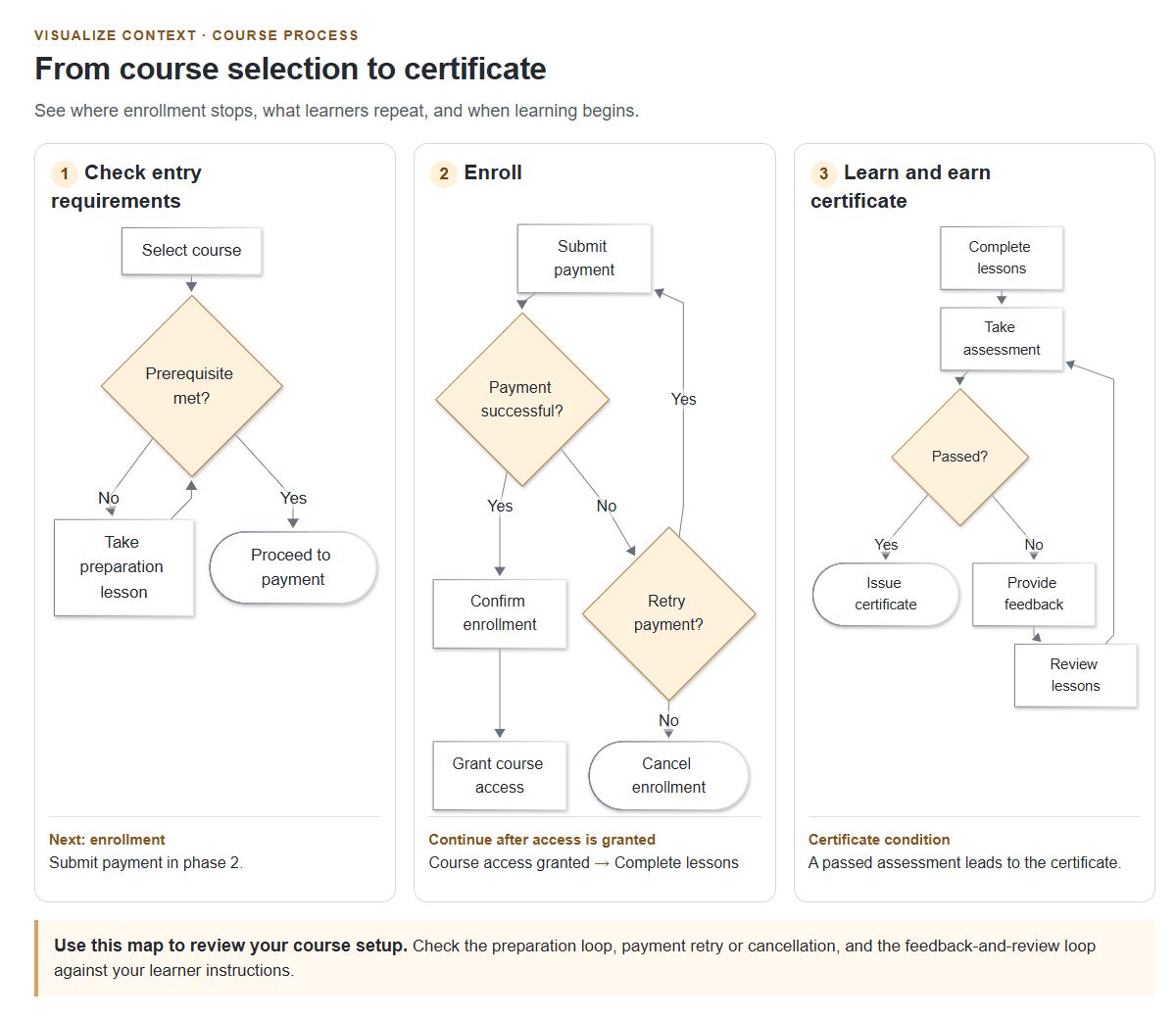
Select the map to view full size.
Check your course setup against these paths. Can learners recheck the requirement after preparation, retry a failed payment or cancel, and review lessons after feedback before retaking the assessment? Use the map to check that these routes appear in your setup and learner instructions. Course access follows successful enrollment; a certificate follows a passed assessment.
Connects securely to your tools. The creator never sees your data.
About this skill
Required for the full visual experience: ChatGPT with the built-in visualize plugin available and enabled. That plugin is not included in this package. Claude rendering compatibility is unverified, and rendered or interactive visuals may not work there.
Make complex information easier to understand with a visual that answers your question. Visualize Context is for learners, teachers, researchers, and planners working with notes, instructions, processes, or research material.
Provide your source material and say what you want to understand. Request a format or let the skill choose one. You get reusable guidance for choosing a faithful format, writing short labels, distinguishing headings from descriptions, and keeping important exceptions and unknowns visible.
Flowchart branches stay compact. Journey maps label actions and stated feelings. Storyboards separate scene titles from descriptions and use arrows to show progression. If a requested chart does not fit the evidence, the skill explains why and suggests a useful alternative.
The 20 visual formats covered
- Flowchart — Steps and conditions.
- Mind map — Themes around a central topic.
- Concept map — Labeled connections between ideas.
- Decision tree — Choices and their possible paths.
- Relationship map — Connections among people, ideas, or things.
- System diagram — Parts and what they exchange.
- Cycle diagram — A process that repeats.
- Feedback loop — An effect that influences an earlier part.
- Cause-and-effect diagram — Contributors to an outcome.
- Sequence diagram — Ordered exchanges between participants.
- Timeline — Events over time.
- Hierarchy diagram — Categories or levels.
- Venn diagram — Shared and distinct group membership.
- Comparison matrix — Options compared using the same criteria.
- Quadrant chart — Items positioned along two dimensions.
- Journey map — Actions, stated feelings, and difficulties across stages.
- Storyboard — A scenario explained through connected scenes.
- Gantt chart — Task timing, overlap, and dependencies.
- Sankey diagram — Quantities flowing between groups.
- Funnel diagram — A group narrowing through stages.
Setup and limits
The format reference supplies guidance; actual rendering depends on ChatGPT's available visualize capabilities. Static Mermaid diagrams or Markdown tables can be provided where supported when inline rendering is unavailable. The package is not a standalone diagram editor or rendering engine.
No executable scripts, API keys, or credentials are bundled. Normal Agensi and agent-provider charges may apply. Local guidance and examples were tested in Codex; Agensi delivery, ChatGPT marketplace delivery, and Claude compatibility remain untested. Faster learning and savings in time, tokens, or money have not been demonstrated.
How to use
Skills on Agensi run inside your AI agent. Copy the prompt, paste it into your agent, and it connects to Agensi and installs this skill for you. If a payment is needed, your agent shows it to you first.
Reviews
No reviews yet
Be one of the first to try it. Every listed skill passes our trust checks below.
Security scanned
Passed our 8-point scan before listing
Fresh listing
Recently published to Agensi
Money-back guarantee
Doesn't do what its page promises? You get your money back.
Trust & safety
Security scanned
Verified clean 7 days ago
- Passed all security checks, Safe to install