More screenshots
Works with the AI Agents you already use
 Claude Code
 Cursor
 Codex CLI
 DeepSeek
 Muse+22 moreClaude CodeCursorCodex CLIDeepSeekMuse
 Dots
 Manus
 Grok
 Grok Bot+18 agents
Research Dossier — Visual, Citation-Checked Literature Revie
Automated academic literature review generator that synthesizes papers into print-ready HTML and Pandoc reports.
Free

Research Dossier — Visual, Citation-Checked Literature Revie
Example session with this skill installed
Write a literature review from my research folder for my master's proposal — answer first, organised by theme, honest about where the evidence disagrees. I need it in Word and with BibTeX.
- Read your context and instructions
- Compiled the research dossier
- Generated the document
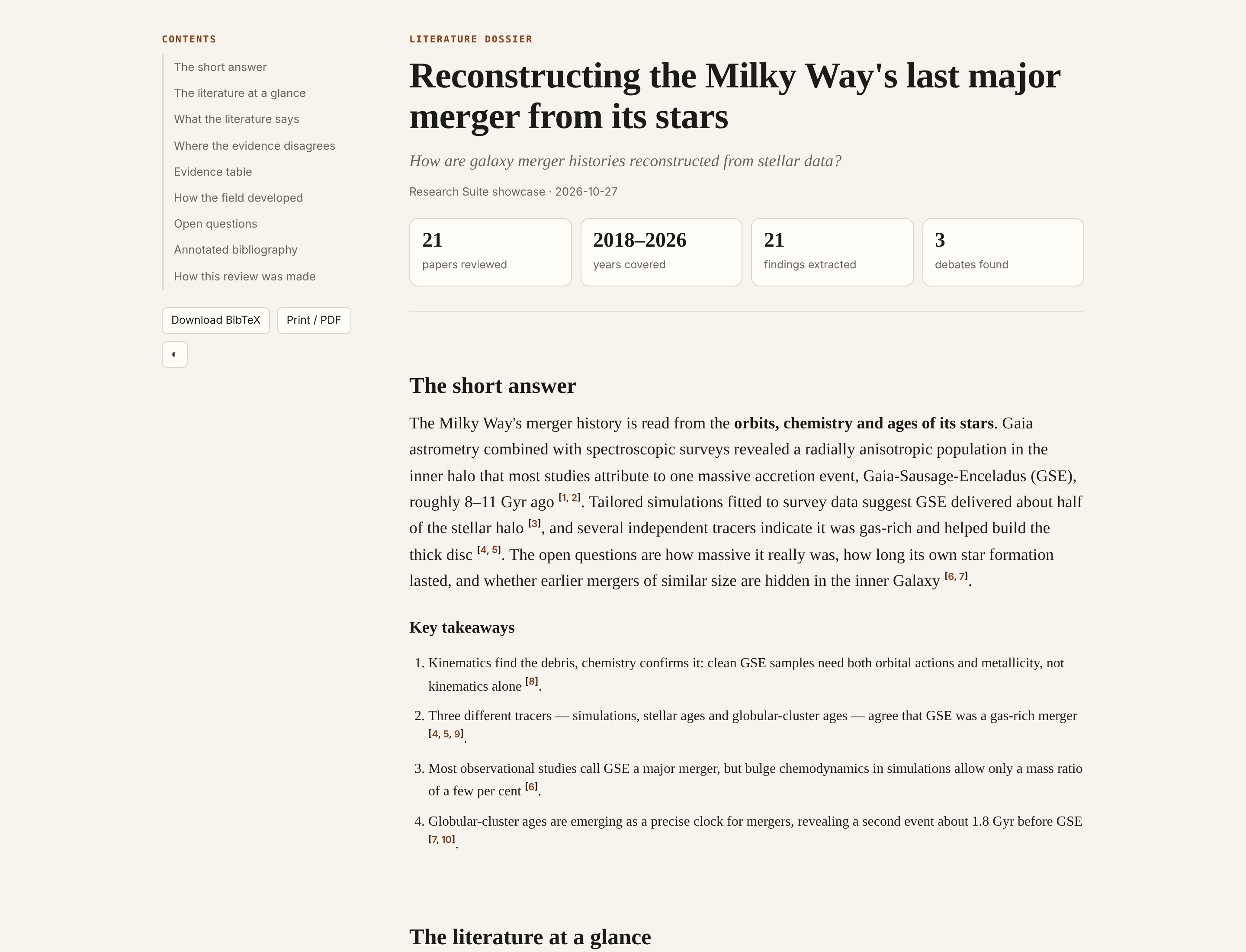
The short answer: The Milky Way's merger history is read from the
orbits, chemistry and ages of its stars. Gaia astrometry combined with spectroscopic surveys revealed a radially anisotropic population in the inner halo that most studies attribute to one massive accretion event, Gaia-Sausage-Enceladus (GSE), roughly 8–11 Gyr ago. Tailored simulations fitted to survey data suggest GSE delivered about half of the stellar halo, and several independent tracers indicate it was gas-rich and helped build the thick disc. The open questions are how massive it really was, how long its own star formation lasted, and whether earlier mergers of similar size are hidden in the inner Galaxy.
Key takeaways
- Kinematics find the debris, chemistry confirms it: clean GSE samples need both orbital actions and metallicity, not kinematics alone.
- Three different tracers — simulations, stellar ages and globular-cluster ages — agree that GSE was a gas-rich merger.
- Most observational studies call GSE a major merger, but bulge chemodynamics in simulations allow only a mass ratio of a few per cent.
- Globular-cluster ages are emerging as a precise clock for mergers, revealing a second event about 1.8 Gyr before GSE.
Structure of the review
- Finding the debris: kinematics plus chemistry — 5 papers
- A gas-rich merger that shaped the disc — 5 papers
- The progenitor's own history, from abundances — 3 papers
- Clocks for other mergers: globular clusters and streams — 5 papers
Plus
3 debates (GSE's mass, its star-formation timescale, the in-situ halo) shown with the competing claims side by side, an evidence table of 21 findings, a timeline,
4 open questions, and an annotated bibliography of 21 references.
Every citation was checked against the paper set before building — 20 papers cited, 0 unknown citations, 1 included review not cited (listed under further reading).
Files
dossier.html— the full report (charts, contents sidebar, light/dark, prints to PDF, Download BibTeX button)dossier.md— numbered citations + APA-style reference list for Word or Google Docsdossier.pandoc.md+references.bib— for Word in any citation style:
pandoc dossier.pandoc.md --citeproc -o review.docx
Before submitting: findings were extracted from abstracts; read the key papers in full, especially Fragkoudi et al. 2020 and Plevne et al. 2025 (a preprint).
dossier.html
PDF · document
Example file from a real run - the skill writes it into your workspace.
Connects securely to your tools. The creator never sees your data.
About this skill
Turning a collection of research papers into a cohesive literature review is time-consuming and prone to citation errors. This skill automates the synthesis of academic papers into a structured, print-ready dossier with traceable evidence.
What it does
- Thematic synthesis groups findings by methodology, population, or mechanism rather than paper-by-paper summaries.
- Conflict mapping identifies and explains disagreements between studies using a dedicated debates section.
- Automated bib-sync ensures every citation is mapped to a real entry in your bibliography with no invented references.
- Multi-format export generates print-ready HTML, standard Markdown, and Pandoc-ready files with BibTeX support.
- Evidence tables builds a structured summary of data points, sample sizes, and key findings across the entire paper set.
How it works
- Input gathering parses your
papers.jsonand optional claim/conflict files to understand the research landscape. - Synthesis planning identifies the core research answer and 3-6 distinct themes to organize the evidence.
- JSON schema generation writes the
synthesis.jsonfile containing the structured review, annotations, and open questions. - Local build execution runs a Python script to validate citations and compile the final HTML and Markdown assets.
Frameworks & tools
Standard-library Python, Pandoc-ready Markdown, BibTeX, and HTML/CSS for report generation.
Why this beats prompting it yourself
Generic prompts often hallucinate citations or summarize papers in isolation. This skill enforces a schema that requires every claim to map to a specific key in your JSON database, ensuring 100% citation accuracy and thematic rather than chronological organization.
Use cases
- Drafting the "Related Work" or "Literature Review" chapter for a thesis or journal submission.
- Creating a centralized research dossier for lab onboarding or grant background research.
- Synthesizing conflicting evidence in a specific field for clinical or policy decision-making.
Known limitations
Requires papers.json to function. Claim and conflict extraction is limited to abstract content unless full-text claims are provided via claim-conflict-finder.
Find more skills like this on the Claude Skills Marketplace, the Codex Skills Marketplace and the Gemini Skills Marketplace, or browse Claude Skills for Research & Analysis.
Requires papers.json formatted metadata. Conflict analysis is dependent on claims.json availability. Script execution requires a local Python 3 environment.
How to use
- 1
Connect your agent to the Agensi MCP
Copy the prompt and paste it into Claude, ChatGPT, Cursor or any agent that supports MCP. It sets up the connection for you. Manual setup
- 2
Sign in to Agensi
Your agent shows a sign-in link. Sign in and click Allow.
- 3
Ask for what you need
Your agent loads this skill and uses it on your task. It always asks before buying a skill.
Reviews
No reviews yet
Be one of the first to try it. Every listed skill goes through the trust checks below.
Security scanned
Checked by our 8-point scan before listing
Fresh listing
Recently published to Agensi
Free to use
No account required to browse
Trust & safety
Security scan
Security scan passed 21 days ago
- Free with an Agensi account