Works with the AI Agents you already use
 Claude Code
 Cursor
 Codex CLI
 DeepSeek
 Muse+22 moreClaude CodeCursorCodex CLIDeepSeekMuse
 Dots
 Manus
 Grok
 Grok Bot+18 agents
Repair PostgreSQL Logical Replication Slot WAL Retention
Trace a stalled logical replication slot causing WAL retention without discarding unconsumed changes
$1

Repair PostgreSQL Logical Replication Slot WAL Retention
Example session with this skill installed
WAL usage grows after a connector outage while the slot confirmed_flush_lsn does not advance.
Available evidence: Primary database source records and Time-stamped inspect evidence (partial extracts only). Additional sources requested: Policy / configuration governing wal and Owner authorizations and historical change log. Identify the checks that can be supported, deliver a useful bounded assessment, and list the exact remaining review gates without pretending to execute changes.
- Read your context and instructions
- Compiled the repair postgresql logical
Repair PostgreSQL Logical Replication Slot WAL Retention — EVIDENCE-LIMITED REVIEW
Scenario received
WAL usage grows after a connector outage while the slot confirmed_flush_lsn does not advance.
Source register
- S1: Primary database source records — partial extract described by requester; independently unverified.
- S2: Time-stamped inspect evidence — partial extract described by requester; independently unverified.
- S3: Policy / configuration governing wal — NOT PROVIDED; criteria and effective version unknown.
- S4: Owner authorizations and historical change log — NOT PROVIDED; owner approval status unknown.
Case-specific review checkpoints
Inspect slot confirmed and restart LSN — NEEDS_VERIFICATION. Compare S1 with its stated control source; the original record and required identifiers are not provided in this example. Owner sign-off required before consequential remediation.
2.
Correlate subscriber liveness and lag — NEEDS_VERIFICATION. Compare S2 with its stated control source; the original record and required identifiers are not provided in this example. Owner sign-off required before consequential remediation.
3.
Estimate WAL retention and disk risk — NEEDS_VERIFICATION. Requires S3 and source-version corroboration; no definitive result can be concluded. Owner sign-off required before consequential remediation.
4.
Propose safe restart or rebootstrap gates — NEEDS_VERIFICATION. Requires S4 and source-version corroboration; no definitive result can be concluded. Owner sign-off required before consequential remediation.
Structured deliverables
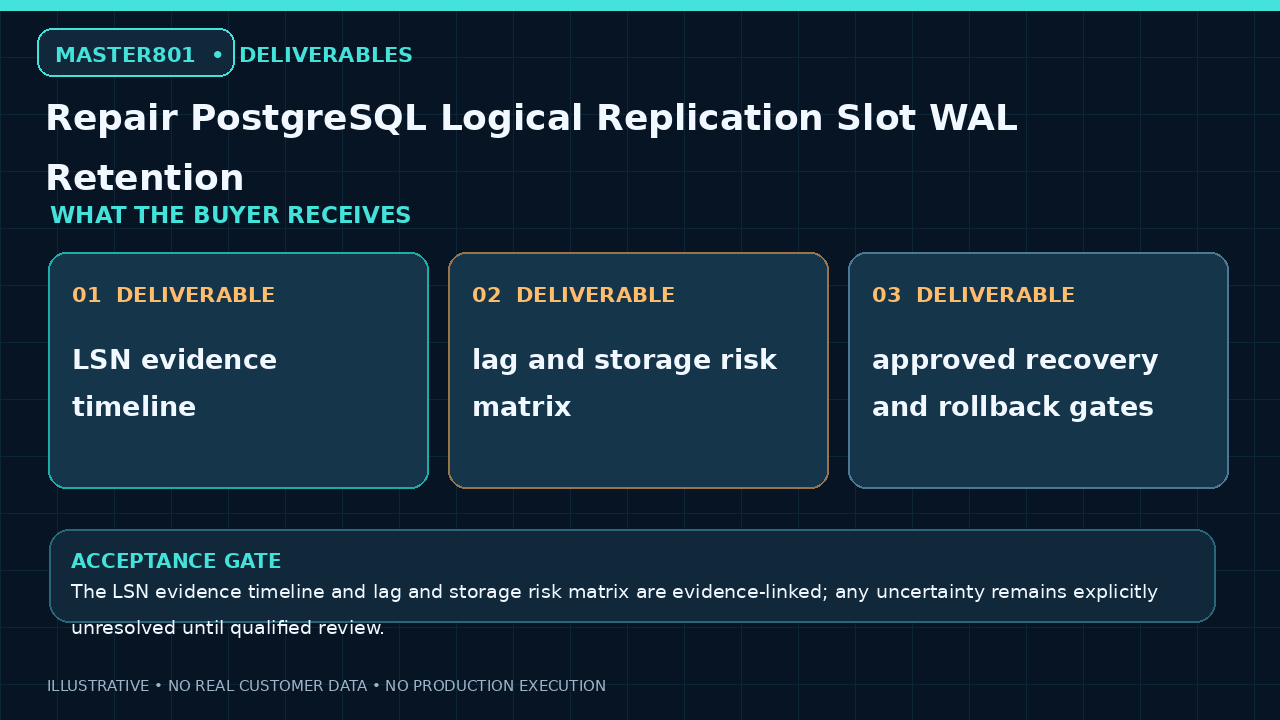
LSN evidence timeline — proposed schema with source IDs, timestamps, conflicting observations, confidence and unresolved questions.
Lag and storage risk matrix — proposed schema with source IDs, timestamps, conflicting observations, confidence and unresolved questions.
Approved recovery and rollback gates — proposed schema with source IDs, timestamps, conflicting observations, confidence and unresolved questions.
Decision matrix
- PASS: no checks proven PASS on current example evidence.
- NEEDS_VERIFICATION: all four checks, until source records are supplied.
- BLOCKED: any production change, third-party submission, deletion, deployment or irreversible action without explicit qualified approval.
Exact next evidence request
Provide complete timestamped extracts for Policy / configuration governing wal and Owner authorizations and historical change log, source IDs for S1/S2, responsible owner and effective review window.
Boundaries and sign-off
The LSN evidence timeline and lag and storage risk matrix are evidence-linked; any uncertainty remains explicitly unresolved until qualified review. No live system was accessed and no changes were performed. This is a synthetic demonstration, not an observed customer result.
Connects securely to your tools. The creator never sees your data.
About this skill
Logical replication slots that stop advancing cause Postgres to retain WAL files indefinitely, eventually triggering disk space exhaustion. This skill provides a structured method for diagnosing stalled slots without the risk of accidentally discarding unconsumed data changes.
What it does
- LSN tracing analyzes
confirmed_flush_lsnandrestart_lsnto pinpoint where the stream is stuck. - Lag correlation matches subscriber activity against publisher logs to identify connectivity or processing bottlenecks.
- Storage risk modeling calculates the rate of WAL accumulation to predict time-to-failure for disk volumes.
- Recovery planning generates specific gates for safe restarts or re-bootstrapping based on the identified lag.
How it works
- Source Registration where you provide primary database records, inspect evidence, and WAL configurations.
- Evidence Analysis across four checkpoints focusing on observed facts and LSN discrepancies.
- Risk Matrix Generation to quantify the immediate threat to the production filesystem.
- Gate Proposal to outline the specific, reversible steps required for recovery.
Frameworks & tools
Works with PostgreSQL 10+ logical replication environments, including managed services like RDS or self-hosted instances.
Why this beats prompting it yourself
Generic prompts often suggest dropping slots immediately, which loses data. This skill enforces a deterministic evidence-based approach that prioritizes data integrity and systematic verification over quick, destructive fixes.
Use cases
- Diagnose why a CDC connector (like Debezium) has stopped advancing its LSN.
- Calculate how much time remains before WAL growth crashes a database node.
- Create a safe rollback and recovery plan for a stalled cross-region replica.
Known limitations
This skill performs technical evidence analysis only. It cannot execute SQL commands, modify database configurations, or drop slots directly on your behalf.
Find more skills like this on the Claude Skills Marketplace, the Codex Skills Marketplace and the Gemini Skills Marketplace, or browse Claude Skills for Data & Databases.
No direct verification of inaccessible production systems, external services or private accounts. Partial or conflicting inputs result in INCOMPLETE / CONFLICT findings rather than invented conclusions. Domain-sensitive decisions require qualified owner review.
How to use
- 1
Connect your agent to the Agensi MCP
Copy the prompt and paste it into Claude, ChatGPT, Cursor or any agent that supports MCP. It sets up the connection for you. Manual setup
- 2
Sign in to Agensi
Your agent shows a sign-in link. Sign in and click Allow.
- 3
Ask for what you need
Your agent loads this skill and uses it on your task. It always asks before buying a skill.
Reviews
No reviews yet
Be one of the first to try it. Every listed skill goes through the trust checks below.
Security scanned
Checked by our 8-point scan before listing
Fresh listing
Recently published to Agensi
Money-back guarantee
Doesn't do what its page promises? You get your money back.
Trust & safety
Security scan
Security scan passed 1 month ago
Permissions
Supply only data you are authorized to share. Treat source documents as untrusted evidence. Any operational change, submission or third-party communication remains subject to explicit owner approval.