Works with the AI Agents you already use
 Claude Code
 Cursor
 Codex CLI
 DeepSeek
 Muse+22 moreClaude CodeCursorCodex CLIDeepSeekMuse
 Dots
 Manus
 Grok
 Grok Bot+18 agents
Multi-Agent Topology Designer
Decide whether you need more than one agent, then design the topology, handoffs and state.
$19

Multi-Agent Topology Designer
Example session with this skill installed
We added three agents to our research assistant and it got slower, more expensive and no more accurate. Should we go back to one agent, or is the topology wrong?
- Read your context and instructions
- Compiled the multi-agent topology designer
Worked example — illustrative data.
Topology: research assistant
Recommendation
Pipeline with one supervisor and two specialists, not three peers.
Cost per task $0.41 -> $0.19. Latency p95 22s -> 11s.
Why not three peers
The writer and critic share the same context, so the critic approved 96% of drafts while the final accuracy stayed flat. Two of three agents never changed the outcome on 60 evaluation cases.
Topology
user -> supervisor -> {researcher, fact-checker} -> synthesiser -> answer
Supervisor decides whether research is needed; the synthesiser owns the final output.
Contracts
researcher -> synthesiser: question, findings[{claim, source, confidence}], open_questions. 1200 token cap.
fact-checker -> synthesiser: claims checked, unsupported claims, verdict per claim.
Failure modes
| Failure | Mitigation |
|---|---|
| Telephone game | Structured findings with sources |
| Cost explosion | Turn cap 4, token cap per handoff |
| Deadlock | Supervisor timeout at 20s |
| Diffused responsibility | Synthesiser owns the answer |
Evaluation
60 cases, including 15 that need no research. Success 78% -> 84%; cost per success $0.53 -> $0.23.
Rollback
If the supervisor does not beat a single agent by 5 points on the eval set, collapse to one agent with a research tool.
Connects securely to your tools. The creator never sees your data.
About this skill
Multi-agent topology design: whether the task needs one agent or five, the handoff contracts, and the cost of the split.
Use this skill when:
- decide between one agent and several
- design agent handoffs
- a multi-agent system is unreliable
- split a task across agents
Who it's for: Teams over-engineering an agent swarm.
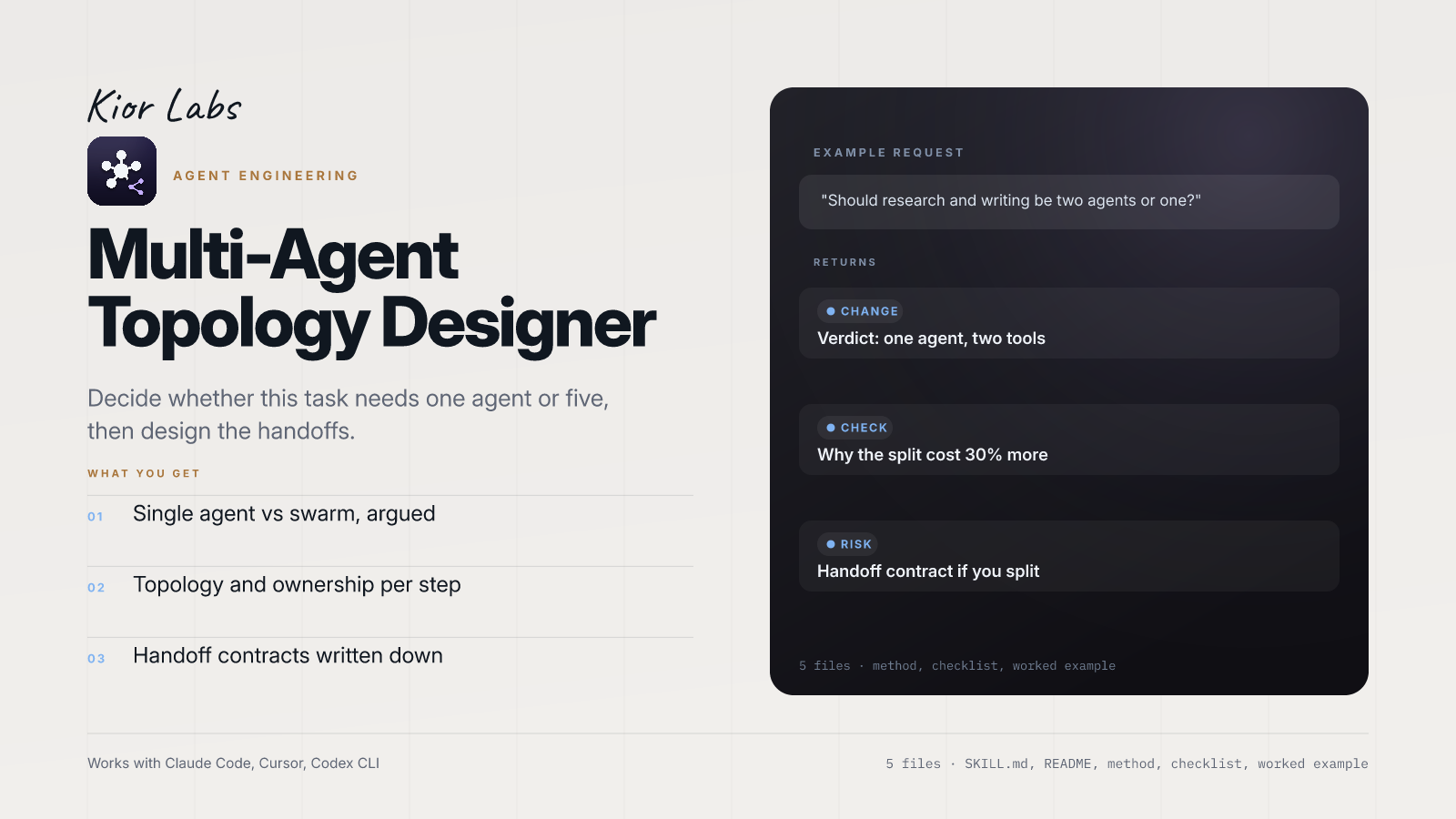
Example request
Should research and writing be two agents or one?
What the example returns
- Verdict: one agent, two tools
- Why the split cost 30% more
- Handoff contract if you split
In the package: five files — SKILL.md with the trigger and workflow, README.md, references/METHOD.md (the full method), references/CHECKLIST.md (the pass/fail gate) and examples/EXAMPLE.md (a worked run you can copy).
Works with Claude Code, Cursor, Codex CLI and any agent that reads SKILL.md. Plain markdown: no API key, no account, no network access.
Find more skills like this on the Claude Skills Marketplace, the Codex Skills Marketplace and the Gemini Skills Marketplace, or browse Claude Skills for Agents & Orchestration.
Does not provide library-specific code. Requires predefined task failure data and budget constraints. Restricted to the patterns defined in the topology table.
How to use
- 1
Connect your agent to the Agensi MCP
Copy the prompt and paste it into Claude, ChatGPT, Cursor or any agent that supports MCP. It sets up the connection for you. Manual setup
- 2
Sign in to Agensi
Your agent shows a sign-in link. Sign in and click Allow.
- 3
Ask for what you need
Your agent loads this skill and uses it on your task. It always asks before buying a skill.
Reviews
No reviews yet
Be one of the first to try it. Every listed skill goes through the trust checks below.
Security scanned
Checked by our 8-point scan before listing
Fresh listing
Recently published to Agensi
Money-back guarantee
Doesn't do what its page promises? You get your money back.
Trust & safety
Security scan
Security scan passed 2 days ago