Works with the AI Agents you already use
 Claude Code
 Cursor
 Codex CLI
 Muse
 Dots+22 moreClaude CodeCursorCodex CLIMuseDots
 OpenClaw
 Manus
 Grok
 Grok Bot+18 agents
KR Stock Research Kit
It helps AI agents turn filings, market data, analyst coverage, and recent news into structured, dated research with traceable sources.
Free

KR Stock Research Kit
Example session with this skill installed
Use KR Research Kit to analyze Hanwha Engine (KRX: 082740) and write a full decision memo for a potential new investment over the next 12–24 months.
Use July 12, 2026 as the research cutoff. Review DART filings, backlog quality, margins, customer concentration, capacity expansion, acquisitions, valuation, and technical positioning. Include available analyst views and flag evidence you cannot verify.
Include financial tables, charts, catalysts, risks, uncomfortable questions, conditions that would change the investment stance, and source links. Save the memo and supporting artifacts.
- Read your context and instructions
- Compiled the kr stock research
- Generated the data export
Hanwha Engine (082740): A 12–24-Month New-Investment Decision Memo
- Research date: July 12, 2026
- Last updated: July 12, 2026
- Price reference: KRW 46,600, KRX close on July 10, 2026, the preceding trading day
- Market / security: KOSPI / Hanwha Engine common shares
- Output mode: Full decision memo
Summary Judgment
The key question: Will the substantial order backlog translate into earnings and cash flow?
Hanwha Engine's backlog and first-quarter profitability are attractive. For a new investment over 12–24 months, however, the appropriate stance is
a staged approach conditional on earnings confirmation. Q1 2026 backlog of KRW 5.24 trillion and an operating margin of 14.9% provide strong evidence. At the reference price, the stock trades at approximately 22.4 times FY2025 earnings and 7.0 times book value. Product-level margins, aftermarket revenue recurrence, and annual backlog conversion have not been verified through disclosures.
As of July 10, the share price was below its 5-, 20-, 60-, 120-, and 200-day moving averages and failed the Minervini rules. Recognize the favorable business cycle while checking profitability, utilization, capital expenditure, and Hanwha Ocean concentration from Q2 onward.
Decision Frame
| Decision axis | Current assessment | Evidence that would change the decision |
|---|---|---|
| Order visibility | Positive | Q1 backlog of KRW 5.24T; delivery-based revenue timing and margins remain undisclosed. |
| Earnings quality | Improvement confirmed; durability uncertain | Whether Q1's 14.9% operating margin persists through Q2 and H2, and whether higher-specification mix explains it. |
| Customer / group structure | Opportunity and risk coexist | Hanwha Ocean reached 40.3% of revenue. Transaction terms, receivable collection, and outside-customer expansion matter. |
| New businesses / capex | Optionality; no immediate earnings proof | ESS transaction completed March 31; SEAM closed April 1. Verify purchase-price allocation, net debt, and earnings contribution. |
| Valuation / technicals | Demanding / entry deferred | FY2025 P/E of 22.4x and P/B of 7.0x require a recovering trend and stronger earnings. |
Business and Thesis
Hanwha Engine is a Hanwha Group operating company producing large low-speed marine engines, engine parts and aftermarket services, selective catalytic reduction systems (SCR), and diesel power-generation equipment. The thesis centers on higher-priced and environmentally compliant vessel orders converting into engine deliveries and profits, and capacity expansion relieving production constraints.
Official Q1 2026 backlog was KRW 5.243T, or 3.02 times FY2025 consolidated revenue. This is a simple backlog-to-revenue calculation. It does not establish profit visibility after delivery timing, costs, exchange rates, and cancellations. The backlog should not automatically be treated as three years of revenue or high-margin business.
Revenue Mix
| Dimension | Disclosed evidence | Assessment |
|---|---|---|
| Product | FY2025 marine engines and SCR: KRW 1,212.6B, 88.4%; aftermarket, diesel generation, rental, and other: KRW 158.5B, 11.6%. | The engine cycle dominates. Standalone aftermarket revenue, margins, and recurring share are not separately disclosed. |
| Environmentally compliant products | Dual-fuel engines command higher prices than conventional diesel engines; methanol assembly-facility modifications and expansion are confirmed. | Price premiums are supported; royalties, costs, and product operating margins are undisclosed. |
| Geography | Q1 direct exports plus local exports: KRW 328.6B, 95.2%. | Significant exposure to exchange rates and overseas shipbuilding demand. |
| Customers | FY2025: Hanwha Ocean 36.8%, Samsung Heavy Industries' Geoje yard 34.7%; Q1 2026: Hanwha Ocean 40.3%. | Concentration creates both shipbuilding-cycle exposure and customer risk. |
What the Latest Results Say
FY2025: Consolidated revenue of KRW 1,371.1B, operating profit of KRW 130.1B, a 9.5% operating margin, and net income of KRW 173.8B. The comparative FY2024 revenue disclosure is on a standalone basis, so a mechanical consolidated year-over-year growth calculation is inappropriate.
Q1 2026: Consolidated revenue of KRW 345.2B, operating profit of KRW 51.4B, a 14.9% operating margin, and net income of KRW 52.9B. The margin improvement is positive, but undisclosed product and contract profitability prevents treating one quarter as proof of a structural margin change.
Cash flow: FY2025 operating cash flow was KRW +330.3B, investing cash flow KRW −161.1B, and year-end cash KRW 276.7B. Q1 contract liabilities of KRW 665.8B may indicate future revenue, but contract-specific timing is unavailable.
Capacity: FY2025 utilization of 100.7%, investment in progress of KRW 41.5B, and planned investment of KRW 350.4B across reporting periods 28–30 suggest potential bottleneck relief. Improved ROIC requires confirmation of actual spending, utilization, and cash conversion.
DART Recheck
| Claim | Status | Evidence / assessment | Source | Limitation |
|---|---|---|---|---|
| Shipbuilding orders support revenue | Confirmed | Q1 backlog of KRW 5.24T | Quarterly report, May 14, 2026 | Delivery-based revenue and margins undisclosed |
| Dual-fuel, methanol, and SCR structurally raise margins | Partially supported | Dual-fuel price premium, methanol facilities, and SCR orders confirmed | FY2025 annual report | Product costs, royalties, and margins undisclosed |
| Aftermarket provides recurring revenue protection | Partially supported | Parts, services, and preventive-maintenance package strategy confirmed | Annual and Q1 reports | Standalone aftermarket revenue and recurrence undisclosed |
| Hanwha Ocean is both opportunity and concentration risk | Confirmed | Customer share: 36.8% in FY2025, 40.3% in Q1; related-party-note revenue: KRW 553.8B | Annual and Q1 reports | Definitions across tables must not be mixed |
| SEAM and ESS already boosted Q1 results | Contradicted | ESS completed March 31; SEAM closed April 1 | Q1 report | No basis to claim a Q1 earnings contribution |
| Expansion relieves constraints without damaging cash flow | Needs follow-up | Utilization of 100.7%; three-period investment plan of KRW 350.4B | FY2025 annual report | Actual spending, yields, and ROIC unverified |
Street / Alternative Views
The collected Hankyung Consensus metadata included SK Securities (July 8, 2026, BUY / KRW 90,000), IBK Securities (May 26, BUY / KRW 87,000), and Meritz (April 27, BUY / KRW 90,000). This suggests positive expectations for engine demand and sustained profitability. The underlying PDFs and landing URLs were missing, so assumptions, estimates, and an average target price could not be verified. These targets are therefore excluded as valuation anchors.
No Naver blogger met the recurring, non-trading coverage criteria. No Korean news article was verified that jointly identified a foreign broker, date, rating, and target price; a search-wrapper error meant zero foreign-IB articles were actually reviewed. This is an
unverified coverage gap, rather than evidence that coverage does not exist.
Current Valuation Snapshot
| Metric | Value | Basis / interpretation |
|---|---|---|
| Close / market capitalization | KRW 46,600 / KRW 3,888.6B | July 10, 2026 market data |
| Trailing P/E | 22.38x | Market metric using latest fiscal-year EPS of KRW 2,082 |
| P/B | 6.99x | Market metric using latest fiscal-year BPS of KRW 6,666 |
| Forward P/E | Approximately 20.2x | Price divided by consensus FY2026 EPS of KRW 2,306; secondary-source estimate |
| EV/EBITDA | Not cleanly available | No verified current data on a consistent basis |
| FCF yield | Not cleanly available | One year's operating cash flow is insufficient given contract liabilities and working-capital effects |
| Peer: HD Hyundai Marine Engine | Closest structural comparator | Similar low-speed-engine and dual-fuel exposure; differences in customers, group demand, capacity, and earnings recognition limit simple multiple comparisons |
Historical Valuation Bands
A reliable three-to-five-year P/E, P/B, and EV/EBITDA series on a consistent basis could not be assembled from the source set. Mixing dates, standalone and consolidated financials, and estimates would create misleading precision. A follow-up should align consistent month-end FnGuide/WiseReport data with audited consolidated results, then add historical bands and a peer comparison.
Chart and Positioning
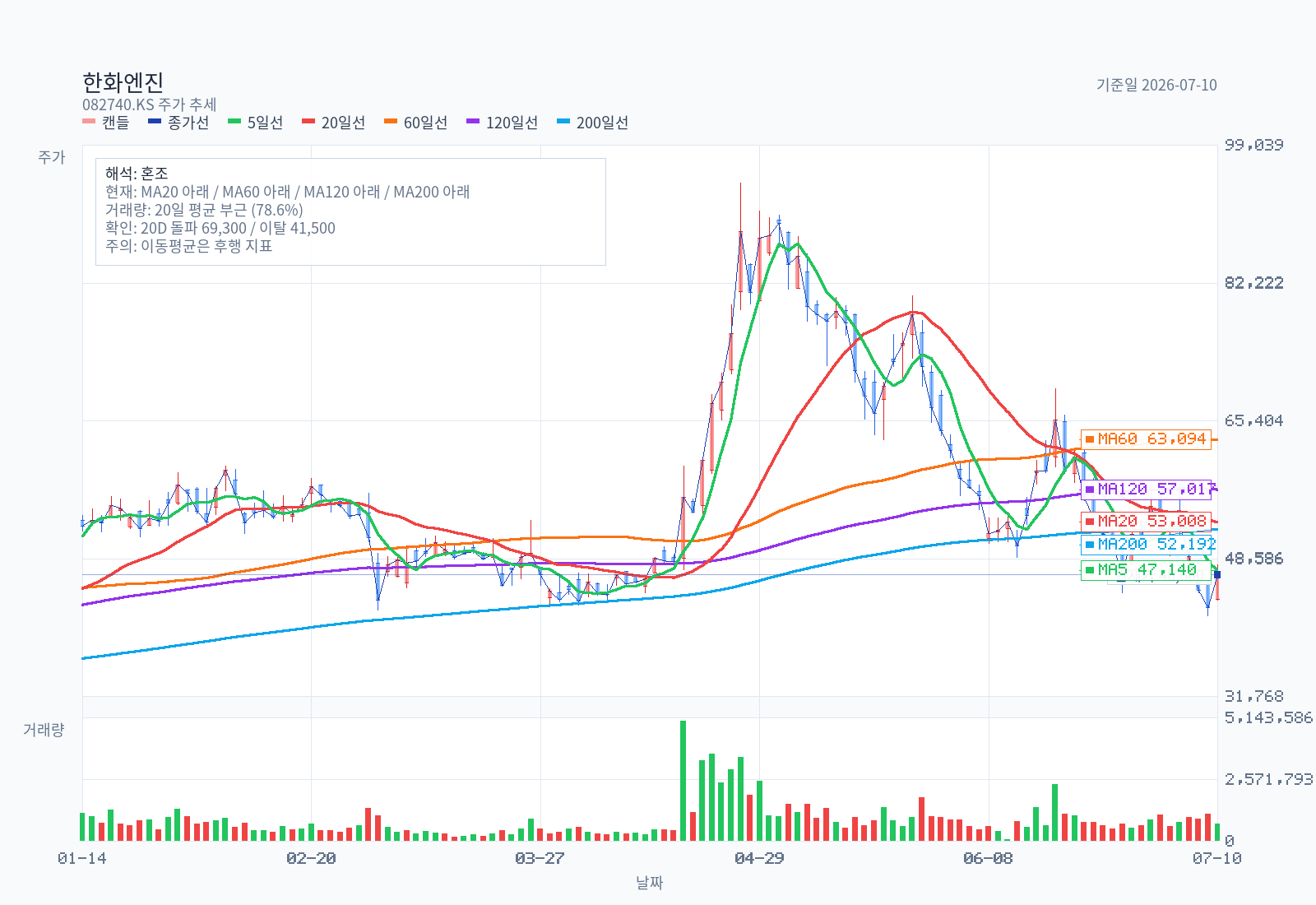
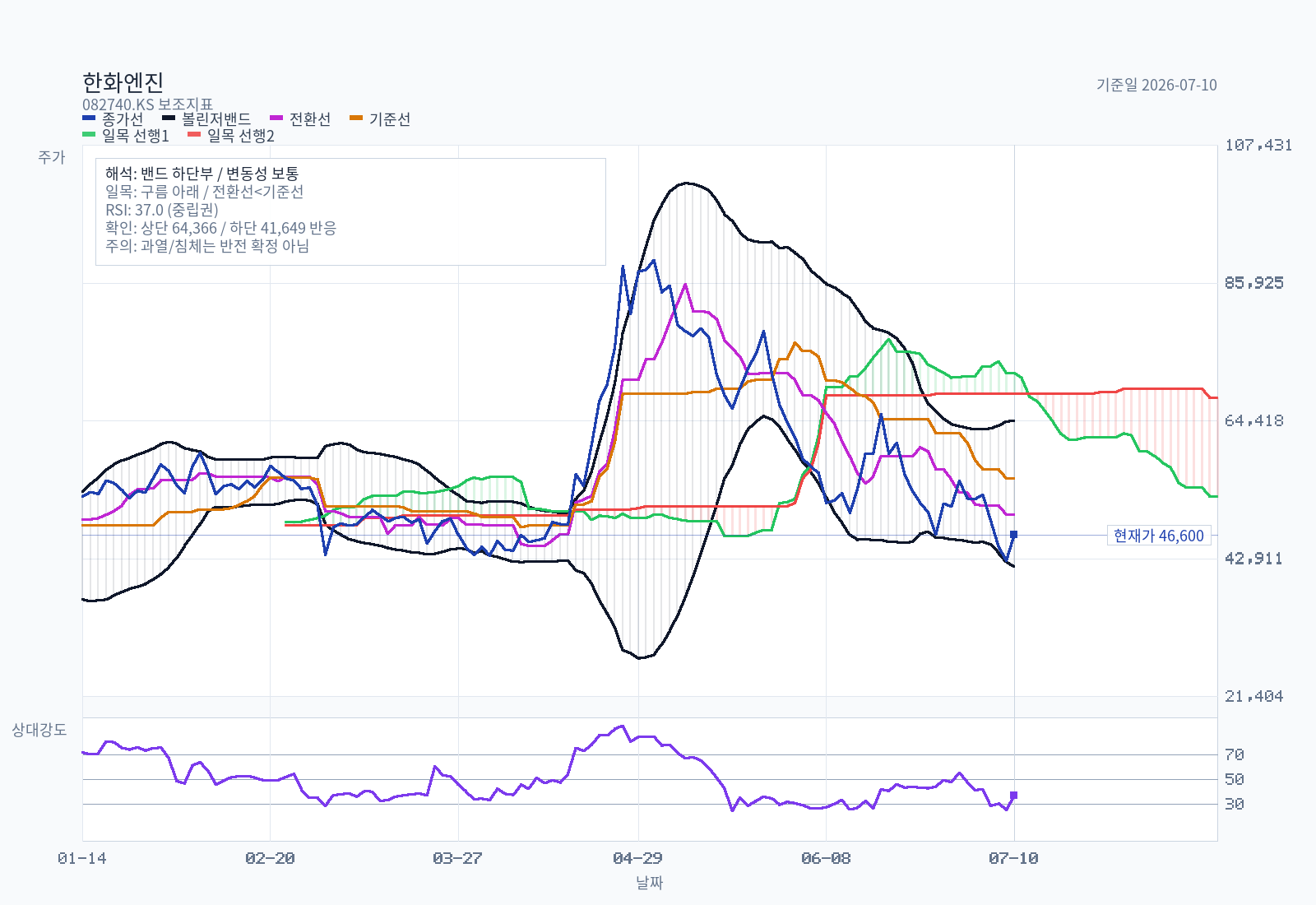
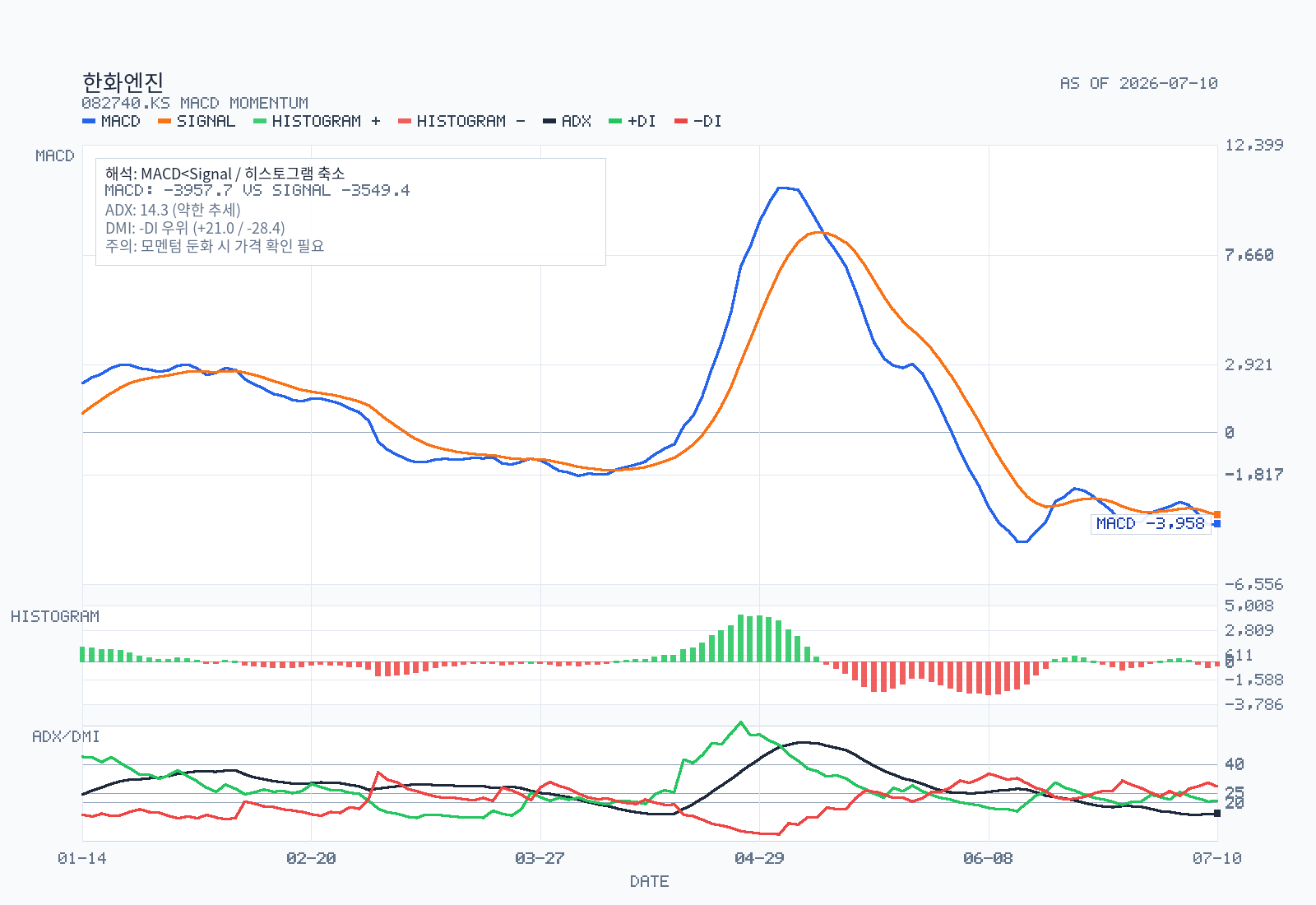
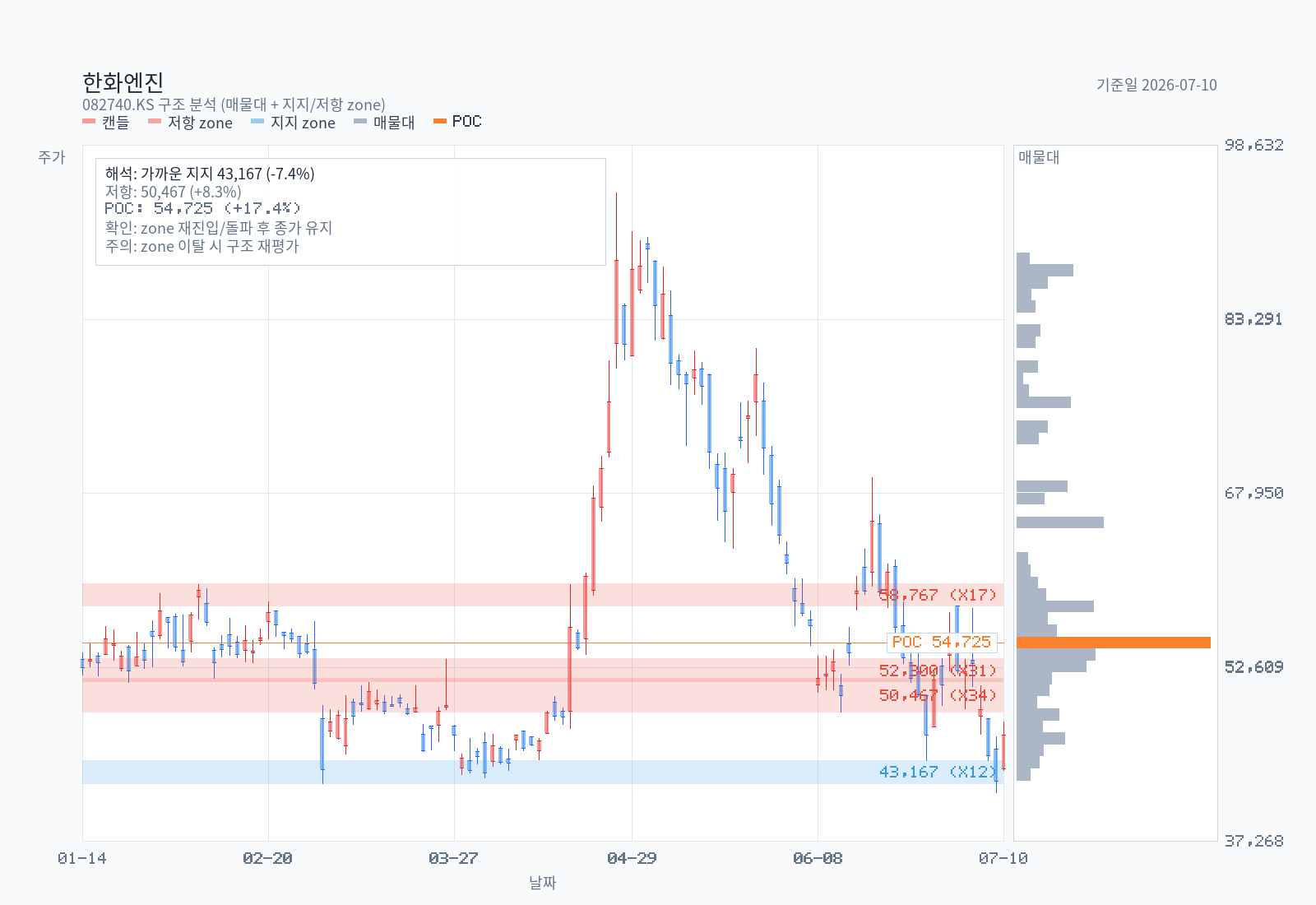
Rule Screen
- Minervini Trend Template: Fail
- KRX 52-week-high leadership score: 48/100, grade D
- Integrated KRX relative-strength percentile: 88.9
| Check | Status | Value |
|---|---|---|
| Price above SMA50 / SMA150 / SMA200 | Fail | KRW 46,600 / 63,349 / 54,477 / 52,192 |
| SMA150 above SMA200 | Pass | KRW 54,477 > 52,192 |
| SMA50 above SMA150 and SMA200 | Pass | KRW 63,349 > 54,477 and 52,192 |
| Price at least 130% of 52-week low | Pass | 185.7% |
| Price at least 75% of 52-week high | Fail | 52.1% |
| RS percentile at least 70 | Pass | 88.9 |
The close is below MA5/20/60/120/200 at KRW 47,140 / 53,008 / 63,094 / 57,017 / 52,192. RSI14 is 37.0, MACD is below zero, and ADX is 14.3, indicating weak downtrend strength. Volume is 78.6% of its 20-day average.
Support is KRW 42,300–44,350. First resistance is KRW 48,600–51,600. The 20-day breakdown confirmation level is KRW 41,500. Full structure zones are recorded in the supporting chart CSV.
The chart-only conclusion is
bearish continuation. Even if the business thesis holds, a recovery and consolidation above KRW 48,600–51,600 is needed before treating the setup as a trend-entry signal.
Governance and Structure
- Hanwha Impact, the largest shareholder, held 32.77% as of December 31, 2025. Hanwha Ocean offers group synergies, while pricing, volumes, and receivable terms can depend heavily on a small number of affiliated companies.
- The annual report identifies seven directors: three executive, one other non-executive, and three outside directors. CEO/chair separation and specific capital-allocation policies were not independently confirmed in this dataset and require rechecking.
- Market data shows 21,607 treasury shares, or 0.03%, which is not a major dilution or cancellation variable. The available evidence is insufficient to assign a shareholder-return premium to dividend or buyback policies.
Catalysts
- Operating margins from Q2 onward remain close to Q1's 14.9%, with evidence of profitable backlog conversion.
- Expansion improves deliveries, output, and cash conversion despite utilization exceeding 100%.
- Orders and revenue diversify beyond Hanwha Ocean, or affiliate transaction terms become more transparent.
- Quantitative disclosure of SEAM purchase-price allocation, net debt, service network, and aftermarket synergies.
- Dual-fuel, methanol-engine, and SCR mix translates into disclosed product or contract-group earnings.
Risks and Disconfirming Evidence
- Lower shipbuilding orders or newbuild prices, and expanding Chinese capacity, could pressure new-order pricing and margins.
- Concentration in Hanwha Ocean and Samsung Heavy Industries' Geoje yard transmits changes in customer production and orders.
- Currency exposure is managed through natural hedges, forwards, and swaps. Q1 dollar forward-sale notional of USD 1.764B and aggregate derivative valuations nevertheless warrant monitoring during sharp currency moves.
- Planned investment of KRW 350.4B could burden cash flow and ROIC if executed after peak demand.
- Warranty provisions of KRW 11.66B, four defendant lawsuits totaling KRW 17.1B, and advance-payment-refund and performance guarantees require continued monitoring.
Uncomfortable Questions
- How much of the KRW 5.24T backlog converts to revenue in each year, and are costs, exchange rates, and royalties already locked in?
- Do dual-fuel, methanol, and SCR price premiums become contribution profit, or are they absorbed by licensing, materials, and expansion costs?
- Is aftermarket genuinely recurring revenue that cushions the cycle, or volatile parts revenue following engine deliveries?
- Does rising Hanwha Ocean exposure reflect group synergy or weakening external-customer diversification?
- Are the KRW 350.4B investment plan and SEAM acquisition high-ROIC solutions to supply constraints, or capital-intensive expansion late in the cycle?
Decision-Changing Issues
| Rank | Issue | Conditions that strengthen or weaken the case |
|---|---|---|
| 1 | Q2 and H2 margins | Sustained mid-teens operating margins with a clear explanation strengthen the case; temporary mix or currency benefits weaken it. |
| 2 | Backlog conversion | Delivery, cancellation, and pricing disclosures that improve 2027–2028 visibility strengthen the case. |
| 3 | Customer concentration | Outside-customer growth and transparent terms help; rising Hanwha Ocean concentration and receivables weaken the case. |
| 4 | Capex and SEAM cash conversion | Confirmed capacity, aftermarket earnings, and ROIC help; rising net debt and cash outflows weaken the case. |
| 5 | Valuation and price trend | Earnings upgrades plus a recovery above KRW 51,600 reduce entry risk; downgrades plus a break below KRW 41,500 support deferral. |
Structured Stance
Current stance: Monitor first; conditional staged buying.
Backlog, Q1 profitability, environmentally compliant engines, and service optionality can support a 12–24-month upside thesis. Current multiples already embed substantial expectations, while the key questions about margins, aftermarket recurrence, and backlog quality remain unresolved in disclosures.
A new investment requires confirmation that high margins recur over the next two quarters, capex and SEAM do not impair cash flow, and Hanwha Ocean concentration does not intensify. Rapid normalization of margins below FY2025 levels because of weaker order pricing or demand—or a break below KRW 41,500 together with earnings downgrades—would invalidate the buying thesis.
Follow-up Research Prompts
- Extract backlog delivery dates, currencies, and cancellation terms from the next quarterly filing to establish revenue and profit timing.
- Verify dual-fuel, methanol, and SCR pricing, licensing, and costs through IR questions or notes to test structural-margin claims.
- Request aftermarket parts and service revenue, recurring-contract counts, and service-network revenue to test the defensive-business assumption.
- Standardize quarterly revenue, receivables, and order shares for Hanwha Ocean and Samsung Heavy Industries to distinguish concentration from affiliate-transaction risk.
- Check September 2026 engine-facility plans, actual capex, capacity, and utilization to assess bottleneck relief and ROIC.
- Check SEAM purchase-price allocation, net debt, consolidated earnings, and post-ESS-transfer orders to quantify costs and synergies.
- Collect consistent month-end peer P/E, P/B, EV/EBITDA, orders, and utilization for HD Hyundai Marine Engine to assess valuation premiums or discounts.
Update Log
July 12, 2026
- Created the memo. Rechecked FY2025 and Q1 2026 filings through DART and incorporated two-year OHLCV, rule screens, domestic report metadata, Naver research, and foreign-IB search results.
- Missing report PDFs, qualifying independent bloggers, and verified foreign-IB articles were retained as limitations on the conclusion.
Sources
- FY2025 annual report — DART, March 18, 2026.
- Q1 2026 quarterly report — DART, May 14, 2026.
- WiseReport company monitor, market indicators checked July 10, 2026.
- Supporting artifacts in the original research folder:
dart-analysis.md,data-pack.md,chart-analysis.md,trend-rules.md,analyst-report-insight.md,naver-insights.md, andforeign-views.md.
84-chart.png
CSV · data export
Example file from a real run - the skill writes it into your workspace.
Connects securely to your tools. The creator never sees your data.
About this skill
KR Research Kit is an integrated skill collection for researching Korean and U.S. equities. It helps AI agents turn filings, market data, analyst coverage, and recent news into structured, dated research with traceable sources.
The toolkit covers the research workflow from scoping a question and gathering evidence to writing company and sector reports, updating existing analysis, and preparing content for publication.
Key capabilities include:
- Company and sector research: Investment memos, earnings analysis, peer comparisons, sector reports, and incremental updates.
- Primary-source analysis: Structured evidence extraction from Korean DART filings and U.S. SEC filings, including financial results, business segments, cash flows, and risk disclosures.
- Analyst coverage: Discovery and summaries of Korean brokerage reports, foreign investment bank views, and independent commentary.
- Charts and market screening: Technical chart generation, relative-strength screening, market leadership analysis, and Korean market sentiment indicators.
- Specialized research: Order backlog analysis and trade-flow inference for businesses where contracts or exports drive performance.
- Strategy backtesting: Reproducible daily-bar backtests for Korean and U.S. equity strategies, with explicit rules, assumptions, and performance records.
- News and publishing: Korean-language daily market news reports for Korean and U.S. markets, Naver Blog post preparation, and optional Telegram delivery.
KR Research Kit prioritizes primary sources, records source dates, and separates disclosed facts from interpretation. Its reusable Markdown, JSON, chart, and report artifacts make research easier to review, maintain, and share
How to use
Skills on Agensi run inside your AI agent. Copy the prompt, paste it into your agent, and it connects to Agensi and installs this skill for you. If a payment is needed, your agent shows it to you first.
Reviews
No reviews yet
Be one of the first to try it. Every listed skill passes our trust checks below.
Security scanned
Passed our 8-point scan before listing
Fresh listing
Recently published to Agensi
Free forever
No account required to browse
Trust & safety
Security scanned
Verified clean 9 days ago
- Free to download with an account
Requires
 GitHub
 Telegram
 Google Account
 Or
 Kiwoom
 Naver
 Co
 Hankyung
 Yahoo
 Bun
 Cnbc
 Dowjones
 Nasdaq
 Seekingalpha
 Investing
 Apnews
 Sec
 Nasdaqtrader