Works with the AI Agents you already use
 Claude Code
 Cursor
 Codex CLI
 DeepSeek
 Muse+22 moreClaude CodeCursorCodex CLIDeepSeekMuse
 Dots
 Manus
 Grok
 Grok Bot+18 agents
Incident Runbook Builder
Turn past incidents into runbooks that work at 3am: signals, triage trees, decisions, verification.
$12

Incident Runbook Builder
Example session with this skill installed
Our runbooks are stale wiki pages. Last month a new on-call engineer took 40 minutes to find out a queue was backed up. Here are our last five incidents with timings.
- Read your context and instructions
- Compiled the incident runbook builder
Worked example — illustrative data.
Runbook: checkout latency and errors
Signal
Alert: checkout p95 above 2s for 5 minutes, or error rate above 2% for 3 minutes. Fires in #alerts-prod.
Impact
Customers cannot complete purchases. Revenue stops. Severity 1 if above 5% for 10 minutes.
First five minutes
- Check deploy: last 30 minutes in the deploy channel.
- If deployed, roll back first, investigate after.
- If not, check database latency and connection pool saturation.
- Post an update in #inc-* within 5 minutes even if unknown.
Triage tree
Error rate also up? yes -> deploy in 30 min? yes -> roll back; no -> DB and dependency latency.
No -> traffic spike vs same hour last week? yes -> autoscaling and queue depth; no -> slow query or pool.
Single region? yes -> infrastructure, failover decision; no -> config or shared dependency.
Decision points
Above 5% error rate and a deploy in the last 30 minutes: roll back. Do not debug forward during business hours.
Verification
A test purchase completes end to end and error rate stays below 0.5% for 10 minutes. Not the absence of alerts.
Owner and review
Payments team, review after each use and quarterly game day.
Connects securely to your tools. The creator never sees your data.
About this skill
Incident runbook generator: detection, triage, decision trees and escalation, built from incidents your team already survived.
Use this skill when:
- write a runbook after an incident
- give on-call a triage guide
- document incident response
- prepare for a launch or peak-traffic event
Who it's for: On-call engineers and SRE leads.
Example request
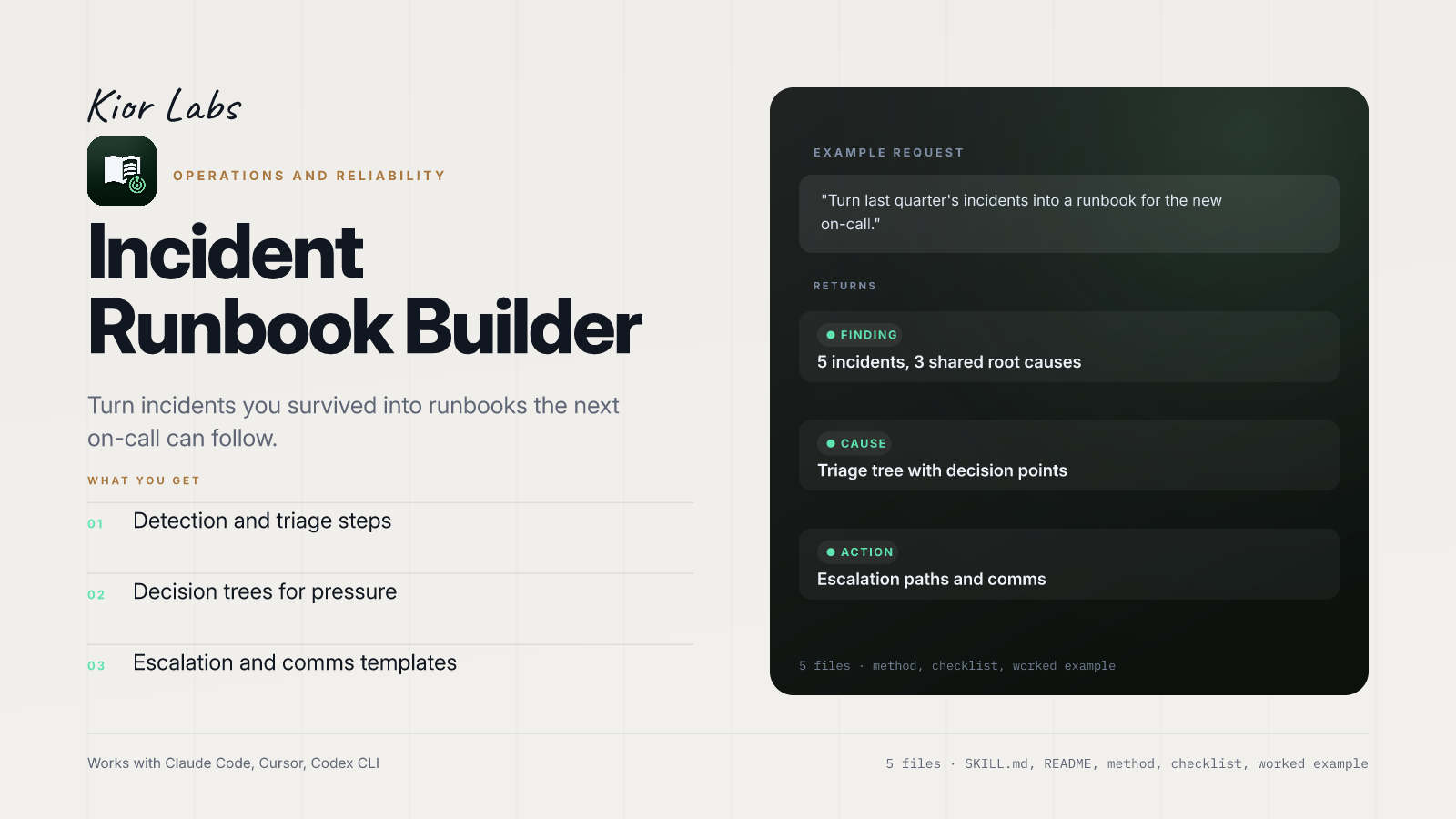
Turn last quarter's incidents into a runbook for the new on-call.
What the example returns
- 5 incidents, 3 shared root causes
- Triage tree with decision points
- Escalation paths and comms
In the package: five files — SKILL.md with the trigger and workflow, README.md, references/METHOD.md (the full method), references/CHECKLIST.md (the pass/fail gate) and examples/EXAMPLE.md (a worked run you can copy).
Works with Claude Code, Cursor, Codex CLI and any agent that reads SKILL.md. Plain markdown: no API key, no account, no network access.
Find more skills like this on the Claude Skills Marketplace, the Codex Skills Marketplace and the Gemini Skills Marketplace, or browse Claude Skills for Business & Operations.
Does not store or manage credentials. Requires manual input of past incident data to identify patterns. Triage trees are text-based diagrams.
How to use
- 1
Connect your agent to the Agensi MCP
Copy the prompt and paste it into Claude, ChatGPT, Cursor or any agent that supports MCP. It sets up the connection for you. Manual setup
- 2
Sign in to Agensi
Your agent shows a sign-in link. Sign in and click Allow.
- 3
Ask for what you need
Your agent loads this skill and uses it on your task. It always asks before buying a skill.
Reviews
No reviews yet
Be one of the first to try it. Every listed skill goes through the trust checks below.
Security scanned
Checked by our 8-point scan before listing
Fresh listing
Recently published to Agensi
Money-back guarantee
Doesn't do what its page promises? You get your money back.
Trust & safety
Security scan
Security scan passed 2 days ago