More screenshots
Works with the AI Agents you already use
 Claude Code
 Cursor
 Codex CLI
 DeepSeek
 Muse+22 moreClaude CodeCursorCodex CLIDeepSeekMuse
 Dots
 Manus
 Grok
 Grok Bot+18 agents
GAVEX
Guarded Audit & Verifier-gated EXecution: step-gated parallel sub-agent orchestration with disjoint Write-Scopes and an independent Verifier enforcing G1-G4 veto gates.
Free
About this skill
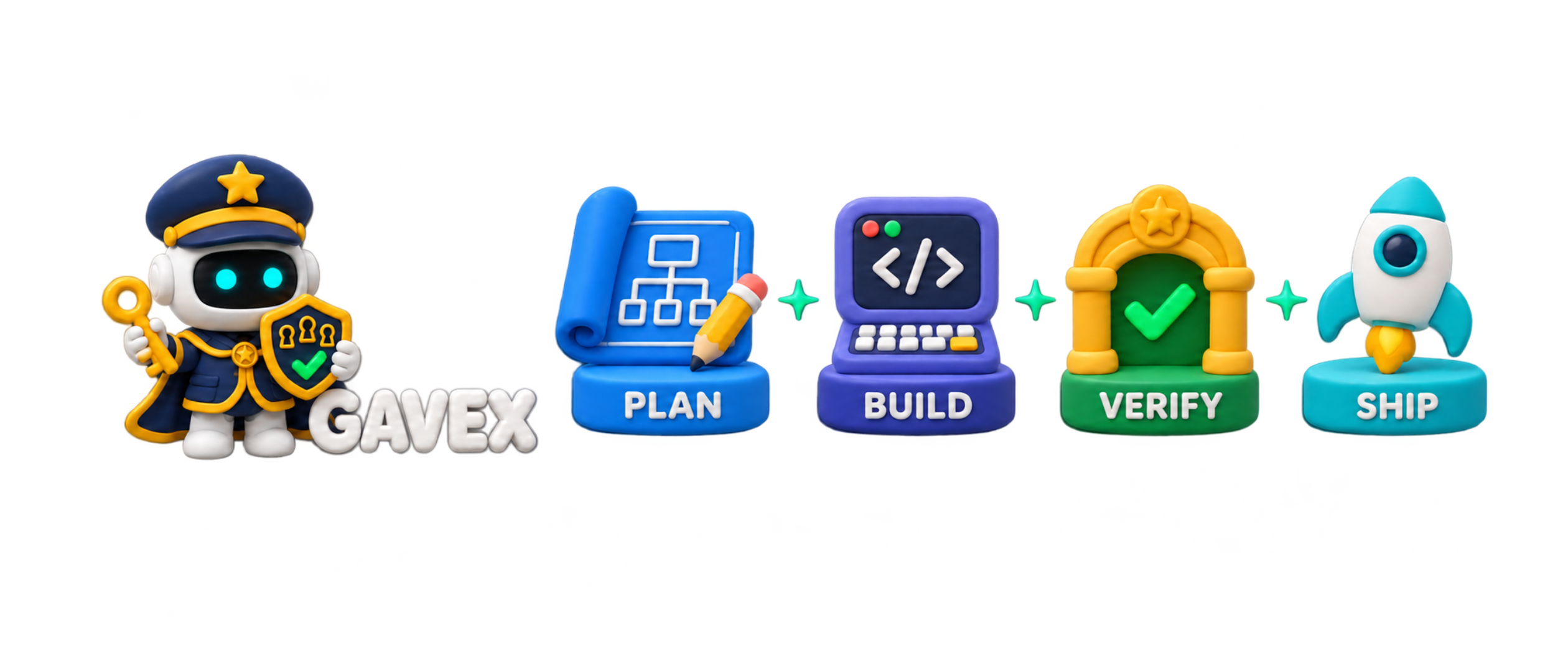 GAVEX solves the problem of unreliable multi-file refactors and high-risk migrations where agents often hallucinate progress or step on each other's toes. It replaces vague "done" status reports with a structured execution protocol that forces parallel workers into disjoint write-scopes. By physically isolating the coding context from the verification context, it ensures that no code is accepted without passing an independent adversarial audit.
What it does
- Multi-step orchestration breaks large features into a sequential ladder of dependencies.
- Disjoint write-scopes prevent parallel workers from creating merge conflicts or overwriting global configurations.
- Independent verification uses a fresh sub-agent to run real-world probes without access to the worker's internal assumptions.
- Adversarial cross-audit runs three different models against each other to find consensus on complex bugs.
- Automated gatekeeping halts the entire pipeline if a step fails G1-G4 security and stability gates.
How it works
- Plan stage generates a step ladder, a non-overlapping write-scope matrix, and a list of executable probes.
- Execute stage spawns parallel workers limited to their specific file paths to complete the step.
- Verify stage calls an independent agent to run entry-point tests and check for regression.
- Accept stage issues a final token only after all steps pass total system integration.
Frameworks & tools
Works with Claude Code, OpenClaw, OpenCode, and any agent runtime supporting spawn, wait, and run primitives.
Why this beats prompting it yourself
Standard prompts let agents grade their own homework, leading to "hallucinated success." GAVEX enforces physical context isolation between the builder and the auditor, making it impossible for the agent to bypass test failures or ignore edge cases.
Use cases
- Refactoring core architecture across 10+ legacy files.
- Implementing multi-module features requiring simultaneous backend and frontend changes.
- Root-causing intermittent production bugs using heterogeneous model consensus.
Known limitations
High overhead for simple one-file fixes. Requires an environment that supports spawning sub-agents or tasks.
Open Source (MIT License): GAVEX is open-source under the MIT License (Copyright (c) 2026 MitsukiJoe). For full source code, local installation (SKILL.md / LICENSE), and free modification or redistribution under MIT terms, visit https://github.com/MitsukiJoe/GAVEX.
Find more skills like this on the Claude Skills Marketplace, the Codex Skills Marketplace and the Gemini Skills Marketplace, or browse Claude Skills for Agents & Orchestration.
Inefficient for simple single-file edits. Requires sub-agent spawning capabilities in the host environment. Scope design relies on initial dependency analysis accuracy.
How to use
- 1
Connect your agent to the Agensi MCP
Copy the prompt and paste it into Claude, ChatGPT, Cursor or any agent that supports MCP. It sets up the connection for you. Manual setup
- 2
Sign in to Agensi
Your agent shows a sign-in link. Sign in and click Allow.
- 3
Ask for what you need
Your agent loads this skill and uses it on your task. It always asks before buying a skill.
Reviews
No reviews yet
Be one of the first to try it. Every listed skill goes through the trust checks below.
Security scanned
Checked by our 8-point scan before listing
Fresh listing
Recently published to Agensi
Free to use
No account required to browse
Trust & safety
Security scan
Security scan passed 12 days ago
- Free with an Agensi account
- Accounts
GitHub
- Software
Git
Permissions
Allowed Hosts