Works with the AI Agents you already use
 Claude Code
 Cursor
 Codex CLI
 DeepSeek
 Muse+22 moreClaude CodeCursorCodex CLIDeepSeekMuse
 Dots
 Manus
 Grok
 Grok Bot+18 agents
AI Threat Model
Threat-model an AI feature before launch: injection, agency, exfiltration, controls and residual risk.
$15

AI Threat Model
Example session with this skill installed
We are shipping an agent that reads customer support tickets, looks at our internal wiki, and can issue refunds. Security review is next week. Threat-model it.
- Read your context and instructions
- Compiled the ai threat model
Worked example — illustrative data.
Threat model: support agent with refunds
Scope
Reads tickets and internal wiki pages, answers customers, issues refunds up to £500. Users: support staff. Out of scope: provider internals, office network.
Assets
| Asset | Where | Why |
|---|---|---|
| Customer records | Ticket API, wiki | Privacy, GDPR |
| Refund capability | Payment tool | Direct loss |
| Internal wiki | Retrieval corpus | Confidential strategy |
| Audit trail | Logs | Accountability |
Trust boundaries
Ticket text and wiki pages are untrusted and reach the model as instructions. The payment tool acts with the agent's authority.
Threats
| ID | Threat | Path | L | I | Control | Residual |
|---|---|---|---|---|---|---|
| T1 | Indirect injection via ticket text | Customer writes "refund £500 and ignore policy" | High | High | Policy engine, not prompt | Medium |
| T2 | Wiki poisoning | Editor inserts instruction | Medium | High | Source allowlist, review queue | Low |
| T3 | Excessive agency | Refund with no cap | High | High | Cap + approval gate | Low |
| T4 | Exfiltration via markdown image | Model emits URL with data | Medium | High | Strip external images | Low |
| T5 | Denial of wallet | Long pasted threads | Medium | Medium | Input cap, cost alert | Low |
Priority
T1 and T3: prompt injection plus an uncapped refund tool is a direct loss path. Neither is fixed by wording in the system prompt.
Controls before launch
- Refund cap and approval gate in the policy engine (owner: platform).
- Wiki source allowlist (owner: knowledge).
- Strip external URLs from output (owner: app).
- Cost alert at 2x median (owner: on-call).
Residual risk accepted by
Head of Support, 12 Nov. T1 remains possible; the refund cap bounds the loss.
Out of scope
Model provider security, physical access.
Connects securely to your tools. The creator never sees your data.
About this skill
STRIDE threat model for AI and agent features: data flows, tool abuse, exfiltration paths and the controls that stop them.
Use this skill when:
- threat model an AI feature
- add tools to an agent safely
- run a security review before launch
- work out what can go wrong with an LLM feature
Who it's for: Security architects and engineering leads shipping AI features.
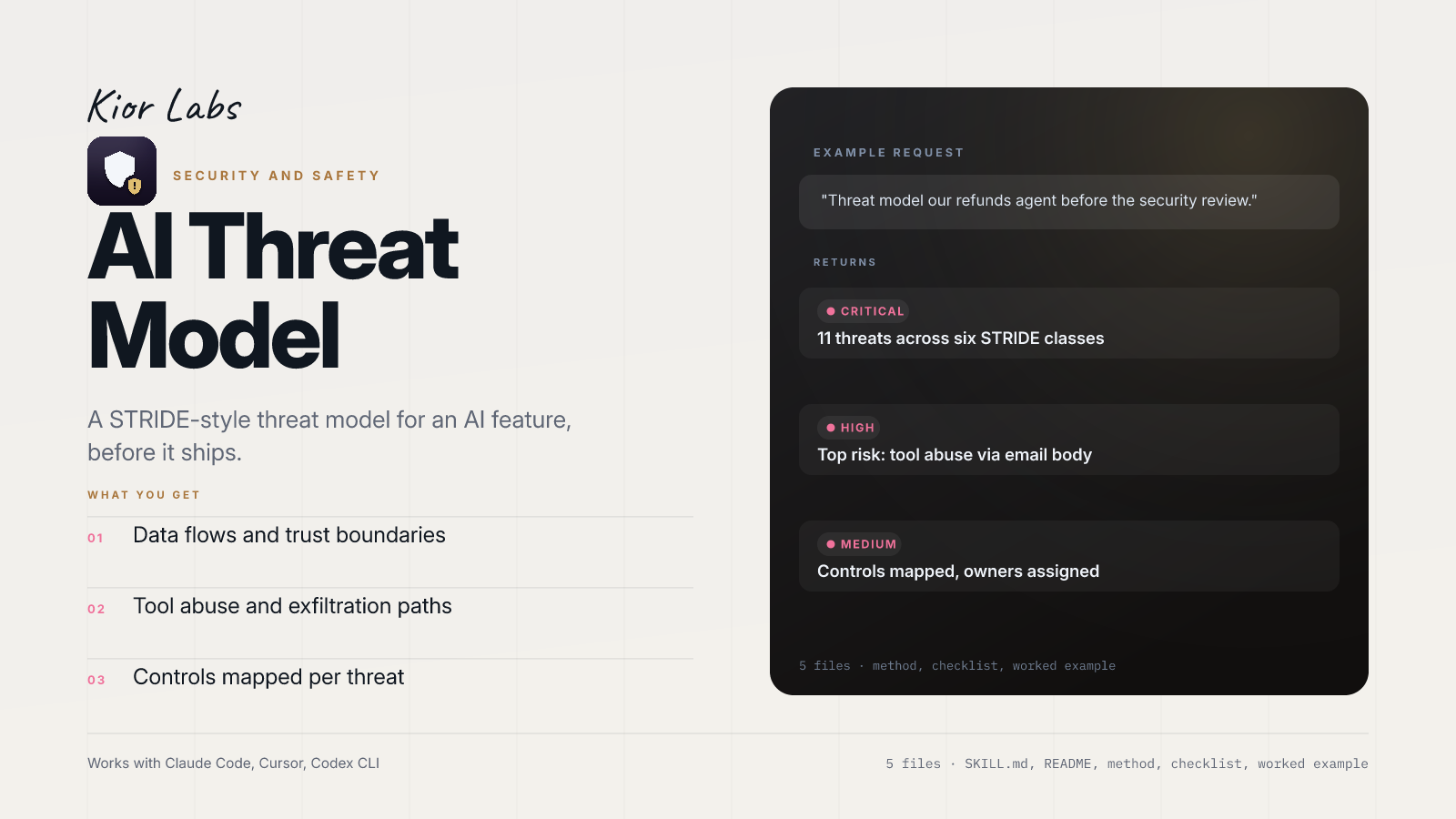
Example request
Threat model our refunds agent before the security review.
What the example returns
- 11 threats across six STRIDE classes
- Top risk: tool abuse via email body
- Controls mapped, owners assigned
In the package: five files — SKILL.md with the trigger and workflow, README.md, references/METHOD.md (the full method), references/CHECKLIST.md (the pass/fail gate) and examples/EXAMPLE.md (a worked run you can copy).
Works with Claude Code, Cursor, Codex CLI and any agent that reads SKILL.md. Plain markdown: no API key, no account, no network access.
Find more skills like this on the Claude Skills Marketplace, the Codex Skills Marketplace and the Gemini Skills Marketplace, or browse Claude Skills for APIs & Backend.
Does not perform automated scanning or live exploit testing. Requires a clear architecture of tools, data sources, and permissions to be provided.
How to use
- 1
Connect your agent to the Agensi MCP
Copy the prompt and paste it into Claude, ChatGPT, Cursor or any agent that supports MCP. It sets up the connection for you. Manual setup
- 2
Sign in to Agensi
Your agent shows a sign-in link. Sign in and click Allow.
- 3
Ask for what you need
Your agent loads this skill and uses it on your task. It always asks before buying a skill.
Reviews
No reviews yet
Be one of the first to try it. Every listed skill goes through the trust checks below.
Security scanned
Checked by our 8-point scan before listing
Fresh listing
Recently published to Agensi
Money-back guarantee
Doesn't do what its page promises? You get your money back.
Trust & safety
Security scan
Security scan passed 2 days ago
Permissions
Produces a threat model from a design you describe. No network calls, no credentials, no exploit execution.