More screenshots
Works with the AI Agents you already use
 Claude Code
 Cursor
 Codex CLI
 DeepSeek
 Muse+22 moreClaude CodeCursorCodex CLIDeepSeekMuse
 Dots
 Manus
 Grok
 Grok Bot+18 agents
AI SEO Citation Audit
There's no 0-100 score, no rank tracking and no projected traffic gain; you get what was measured.
$19

AI SEO Citation Audit
Example session with this skill installed
Run an AI SEO citation audit on exampledeskco.example: the home page, the standing desk height guide and the Frame Pro product page. Competitors are rivaldesks.example and deskreview.example. Use OpenAI and Perplexity for the live tests.
- Read your context and instructions
- Compiled the ai seo citation
(Excerpt. Fictional site; citation numbers come from a mock API.)
ACCESS (site_checks.py, 3 pages)
- CRITICAL /desks/frame-pro: PerplexityBot gets HTTP 403 while a browser gets 200. Likely a CDN bot rule. Confirm in your CDN's bot settings, since real crawlers are also checked by IP.
- HIGH /desks/frame-pro: 482 words after JavaScript vs 0 in the raw HTML. Crawlers that don't run JavaScript see an empty page.
- HIGH /guides/standing-desk-height: X-Robots-Tag "bingbot: noarchive". Bing leaves such pages out of Copilot answers.
- Info: Googlebot and Bingbot look-alikes were refused. That's normal; check URL Inspection in Search Console and Bing Webmaster Tools.
- Policy choice, not an error: robots.txt blocks GPTBot and CCBot (training crawlers). That doesn't remove you from AI search.
PASSAGES (/guides/standing-desk-height)
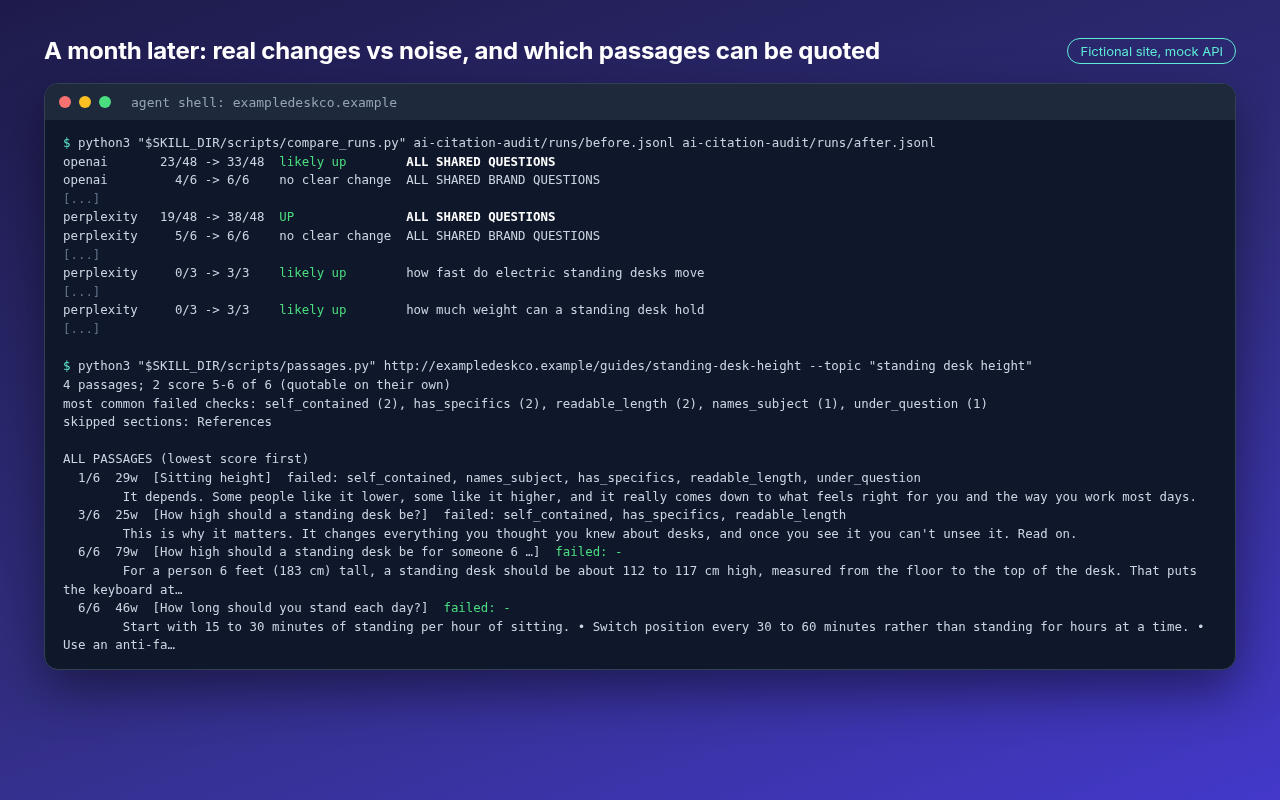
2 of 4 passages can be quoted on their own. "It depends. Some people like it lower…" fails five of the six checks, including no subject, no numbers, and a heading that doesn't match the question.
CITATIONS (18 questions x 3 runs; 108 calls, approved after the dry run)
- openai: cited in 23/48 non-brand answers (48%, 95% interval 34%-62%)
- perplexity: 19/48 (40%, 27%-54%)
- Read but not cited: "best standing desk for tall people" (openai read your page 3/3, cited it 1/3)
- Most-cited instead: deskreview.example (35), rivaldesks.example (28)
- Brand questions, reported separately: openai 4/6, perplexity 5/6
FIXES, in order
- Allow PerplexityBot in the CDN bot rules (bot-blocked). Check: re-run site_checks.
- Server-render the Frame Pro page text (js-dependent-text).
- Replace noarchive with nocache, or remove it, on the guide (noarchive).
- Rewrite the "Sitting height" passage to answer first, with numbers.
ONE MONTH LATER (compare_runs.py)
openai 23/48 -> 33/48 likely up; perplexity 19/48 -> 38/48 UP.
Connects securely to your tools. The creator never sees your data.
About this skill
Can people find your site, both in ordinary search results and in the answers ChatGPT search, Perplexity and Copilot write? Your agent checks the technical side of SEO and AI SEO (also called GEO or AEO): whether search and AI crawlers can get to your pages, whether they're allowed to index and quote them, and, with your own API keys, how often ChatGPT search and Perplexity actually cite you for the questions your customers ask.
Every finding points to the evidence behind it. There's no 0-100 score, no rank tracking and no projected traffic gain; you get what was measured.
Can search and AI crawlers reach your pages?
- Bot blocks. Fetches 3-8 key pages as a browser and as the crawlers (Googlebot, Bingbot, OAI-SearchBot, ChatGPT-User, Claude-SearchBot, PerplexityBot and others) to spot a firewall or CDN rule that turns bots away while browsers get in.
- robots.txt, read the way crawlers read it. Checks each crawler on each exact path with the RFC 9309 matching rules, including what a 4xx, 5xx or rate-limited robots.txt means, and checks every hop when a page redirects.
- Training vs search crawlers kept apart. Blocking GPTBot or Google-Extended is a policy choice, and the skill presents it that way. Blocking OAI-SearchBot, PerplexityBot or Bingbot is what keeps you out of AI answers.
Are your pages allowed to be indexed and quoted?
- noindex, nosnippet, max-snippet and Bing's noarchive (which keeps a page out of Copilot answers), in meta tags and X-Robots-Tag headers, including bot-scoped ones.
- How much text is in the raw HTML versus after JavaScript runs (optional, with Playwright); many AI crawlers don't run JavaScript.
- Every JSON-LD block parsed, a missing title or H1, and canonicals that point elsewhere. llms.txt is reported as information only.
Can an AI answer quote you?
Scores each paragraph and list on six plain yes/no checks (stands on its own, names the subject, has specifics, answer first, length, sits under a matching heading) and quotes the ones that fail with the reason.
Do ChatGPT search and Perplexity cite you? (optional, your own keys)
15-30 real customer questions, asked several times each through the OpenAI Responses API with web search and the Perplexity Agent API. A page counts as cited only when the answer marks the citation inline; when Perplexity returns sources without markers, the answer shows as "cited n/a" and is left out of the rate. You get the citation rate with a 95% interval, which of your pages get cited, questions where the engine read your page but cited someone else, which competitors win, and whether your brand is named (by full or short name). Brand questions are counted separately so they don't inflate the rate.
The agent then opens the competitor pages that were cited and lists, as facts, what they have that yours doesn't.
The report and monthly tracking
A report with fixes in order, each tied to a finding and a way to check it worked. A month later, the same questions and a new run, compared with Wilson intervals: UP, DOWN, likely, or no clear change, with a note when the model or Perplexity preset reported by the API changed.
Spending and keys
Before any paid call, the agent shows a dry run: the number of calls, the endpoints, and the worst case if calls are retried. Nothing is spent until you say yes. Keys are set in your own terminal, never asked for in chat, and never printed, logged, saved or sent on a redirect. Quota and billing errors stop the run instead of retrying.
Safety
Read-only: it changes nothing on your site and writes only to an ai-citation-audit/ folder in your project. The site checks connect only to public addresses (private and loopback IPs are refused, also after redirects) unless you allow a staging host, and cap each download at 5 MB.
Honest limits
It doesn't measure Google rankings or traffic. For Google AI Overviews and AI Mode there's no testing API, so for Google it checks index readiness only. API answers vary between runs and can differ from the ChatGPT and Perplexity apps. Bot blocks are tested with user-agent strings; real crawlers are also verified by IP, so the report tells you to confirm in your CDN logs. Passage scores are heuristics. Nothing here guarantees citations.
What's tested
The scripts are tested on Python 3.9 and 3.13 against a local fictional site (blocked bots, broken robots.txt responses, JavaScript-only pages, redirects to private addresses, slow and oversized responses) and against mock OpenAI and Perplexity servers built from the providers' API docs (rate limits, quota errors, bad keys, redirects, answers without citation markers). A small live run against both real APIs was also done.
By Mausoft Skills. OpenAI, ChatGPT, Perplexity, Google, Bing and Copilot are trademarks of their owners; this skill is not affiliated with or endorsed by any of them.
Find more skills like this on the Claude Skills Marketplace, the Codex Skills Marketplace and the Gemini Skills Marketplace, or browse Claude Skills for Marketing & SEO.
Version 1.0 by Mausoft Skills. Listed as AI SEO Citation Audit; the skill's folder and ID are ai-citation-audit.
Pack contents: SKILL.md, scripts/ (site_checks.py, passages.py, citation_probe.py, compare_runs.py, safe_fetch.py), references/ (ai-crawlers.md, fixes.md, question-set.md), report-template.md, examples/questions-example.txt, README.md.
No packages to install. No API keys of ours, no telemetry, no hosted service. Live tests use your own keys and are billed by the providers; web search is charged on top of tokens.
Install: the skill folder must be named ai-citation-audit. This zip has no top folder (SKILL.md is at its root), so run mkdir -p ~/.claude/skills/ai-citation-audit && unzip ai-citation-audit.zip -d ~/.claude/skills/ai-citation-audit (Cursor: ~/.cursor/skills/ai-citation-audit; other agents: their skills folder, often .agents/skills/ai-citation-audit). Double-click unzip on Mac or Windows creates the folder for you; it must be named exactly ai-citation-audit. A copy with an ai-citation-audit/ top folder unzips straight into the skills folder instead.
Crawler and API facts were checked against the operators' own documentation (OpenAI, Anthropic, Perplexity, Google, Microsoft Bing, Apple, Meta, Common Crawl) and RFC 9309 in October 2026. Crawlers and APIs change; the references say what to re-check.
License: for the purchaser's own projects and their clients' sites; may be modified for that use; no resale or redistribution.
OpenAI, ChatGPT, Perplexity, Google, Bing and Copilot are trademarks of their owners. This skill is not affiliated with or endorsed by any of them.
How to use
- 1
Connect your agent to the Agensi MCP
Copy the prompt and paste it into Claude, ChatGPT, Cursor or any agent that supports MCP. It sets up the connection for you. Manual setup
- 2
Sign in to Agensi
Your agent shows a sign-in link. Sign in and click Allow.
- 3
Ask for what you need
Your agent loads this skill and uses it on your task. It always asks before buying a skill.
Reviews
No reviews yet
Be one of the first to try it. Every listed skill goes through the trust checks below.
Security scanned
Checked by our 8-point scan before listing
Fresh listing
Recently published to Agensi
Money-back guarantee
Doesn't do what its page promises? You get your money back.
Trust & safety
Security scan
Security scan passed 21 days ago
- Software
Python 3.9+
- Optional
- PlaywrightChromium
OpenAI
orPerplexity API key
Python needs only the standard library. Playwright runs the JavaScript check; the API key is for live citation tests.
Permissions
Allowed Hosts
File Scopes
Security disclosure: citation_probe.py reads OPENAI_API_KEY and PERPLEXITY_API_KEY from the environment and sends them only to api.openai.com and api.perplexity.ai (or to an https gateway you set with CITATION_AUDIT_OPENAI_BASE_URL / CITATION_AUDIT_PERPLEXITY_BASE_URL; plain http is accepted only for localhost). It refuses redirects so a key is never sent to a second host, removes the key and recognisable pieces of it from any error text before printing or saving it, and never writes keys to the results file. It makes no call until you pass --yes after seeing the dry run. The site scripts make plain GET requests to the URLs you give, refuse private, loopback and link-local addresses (also after redirects) unless you allow a host, ignore proxy environment variables so that check can't be bypassed, and cap each download at 5 MB decompressed. Nothing on your site is changed. No telemetry. Security scan notes: automated scanners may flag that the probe script reads API keys from the environment (to call those two APIs for you) and that the site checker sends requests with AI crawler user-agent strings (to test whether your firewall blocks them). Both are expected.